What Is Topical Authority? And How to Build One for SEO
Publishing one good article does not automatically make a website an authority on a subject.
Think about it from a search engine’s point of view. If a website has one strong page about home loans but nothing about interest rates, deposits, refinancing, borrowing capacity or loan types, there is not much wider context showing that the site really knows the subject.
That is where topical authority comes in.
Key Takeaways
- Topical authority is about demonstrating expertise across a subject, not simply ranking one page.
- It comes from content depth, breadth, quality and clear relationships between pages.
- Topic clusters, pillar content and internal linking are central to the strategy.
- It is different from domain authority, which is more closely associated with link strength.
- Strong content coverage can support both traditional search visibility and newer AI-led discovery.
What Is Topical Authority?
Topical authority essentially describes how strongly a website demonstrates expertise and relevance around a particular subject. It is built by covering the important parts of that topic in depth, matching different search intents, connecting related pages and keeping the content useful and current.
One thing worth clearing up early: Google does not publish a universal “topical authority score” for normal websites. It is a useful SEO concept for describing subject-level expertise, not a number you can check in Google Search Console.
Think of it as becoming a useful and trusted source around a specific subject rather than having one page that happens to rank for one keyword.
Imagine two websites both publish a page about solar panels. The first has that one article. The second also covers costs, system sizes, batteries, rebates, installation, maintenance and common problems.
The second site gives search engines much more context. Good content planning is about covering what actually matters, not creating pages simply because a keyword tool found another variation.
Is Topical Authority a Google Ranking Factor?
Not in the simple way this question is often presented.
Google does not publish a normal website metric called “Topical Authority” where every domain gets a score out of 100. Its ranking systems mainly assess individual pages while also using some site-wide signals.
Google does have a system called “topic authority”, but it has documented that specifically for news and specialised news queries. The broader SEO idea is an industry framework for describing how well a site demonstrates expertise and relevance around a subject.
Personally, I think it is more useful to treat topical authority as an outcome of good SEO rather than a standalone ranking factor.
Topical Authority vs Domain Authority
These terms are often mixed together, but they describe different things.
| Factor | Topical Authority | Domain Authority |
|---|---|---|
| What it describes | Strength and relevance around a subject | Overall domain strength |
| Scope | Topic-specific | Whole domain |
| Main inputs | Content depth, relevance, expertise and structure | Backlinks, referring domains and backlink profile |
| Link dependence | Links help, but are not the whole strategy | Usually strongly link-based |
| Example | A specialist gardening site covering native Australian plants in depth | A large lifestyle site with a much stronger backlink profile |
A smaller specialist website can sometimes compete with a much larger domain because it covers a niche better. Backlinks still matter, but size alone does not make a site the best answer.
Why Does It Matter for SEO?
The main benefit is that you stop relying on one “hero” page to do all the work. A good cluster allows different pages to answer different parts of the customer journey.
Together, those pages can help you:
- rank for a wider range of searches and long-tail keywords
- strengthen important commercial pages
- create better internal linking opportunities
- help users move naturally between related questions
- spot content gaps before competitors do
- support stronger search rankings across the wider subject
This is where content marketing and SEO work better together. Instead of publishing disconnected articles, you are building a useful subject area that supports both the reader and the business.
It also fits with the wider benefits of SEO. The goal is not one lucky ranking, but a stronger section of the site that can attract relevant users across several stages of their research.
How Can It Support AI Search Visibility?
AI systems often need information from several angles before they can build a useful answer. A broad question can lead to comparisons, follow-up questions and more specific subtopics.
If your website already covers those areas properly, there is more useful source material available and more opportunity for citations and brand mentions.
This overlaps with semantic SEO too. Search engines are not only matching exact words; they are also trying to understand relationships between topics, entities and concepts. Well-built content clusters make those relationships easier to follow.
That does not mean a cluster guarantees AI citations. But connected coverage gives systems more context around what your website knows. Good writing for AI search still matters because every page needs to provide a clear and useful answer on its own.
How to Build Topical Authority
1. Choose the Subject You Actually Need Authority In
Do not start with something too broad. If you sell hiking equipment, trying to own “outdoors” would probably be too vague. Hiking gear or hiking footwear may make far more sense.
The subject should connect to what you sell, what your audience cares about and what you can genuinely cover well.
2. Build a Topical Map
Before writing anything, map the main topic, important subtopics, common questions, comparisons, problems, commercial searches and follow-up questions.
Keyword research is useful here, but I would not build the map from search volume alone. A second layer of keyword research should look at detailed questions and long-tail keywords, while customer conversations can reveal opportunities tools miss.
The point is to identify real content gaps rather than produce a keyword list and call it a strategy.
3. Create a Pillar Page
The pillar page sits at the centre of the topic. This is the main piece of pillar content that explains the broader subject and points readers towards more detailed supporting pages.
4. Build Supporting Content
This is where the depth develops. Cover meaningful subtopics, not every keyword variation.
If “how much does solar cost?” and “solar panel cost Australia” clearly need the same answer, I would usually create one strong page rather than two weak ones competing with each other.
Each supporting article should have a reason to exist and fill a genuine content gap.
5. Match Each Page to a Clear Search Intent
A cluster does not mean publishing ten articles that all answer the same question. Informational, comparison and commercial intent can all live inside the same cluster, but they should not be fighting for the same query.
6. Connect the Pages Properly
Internal linking helps turn a collection of pages into an actual subject hub. Your pillar should connect to important supporting pages, while closely related pages can link to each other where it genuinely helps the reader.
A broader article can naturally lead into a more detailed explanation of technical SEO without adding a forced “read more” line.
7. Add Real Expertise
First-hand experience, examples, original data and expert commentary make a page more useful. They can also strengthen the backlink profile and generate brand mentions over time.
For content marketing teams, this is the important shift: the job is not simply to keep publishing. It is to create material that adds something competitors have not already said ten times.
8. Keep the Cluster Updated
Content coverage is not a one-off sprint. Regulations change, products change, data becomes outdated and new questions appear.
I would periodically look for old statistics, missing subtopics, broken links, duplicated intent and pages that no longer serve a clear purpose. Sometimes the best next step is improving what is already there.
A Real Example: How eCBD Is Building Its AI SEO Cluster
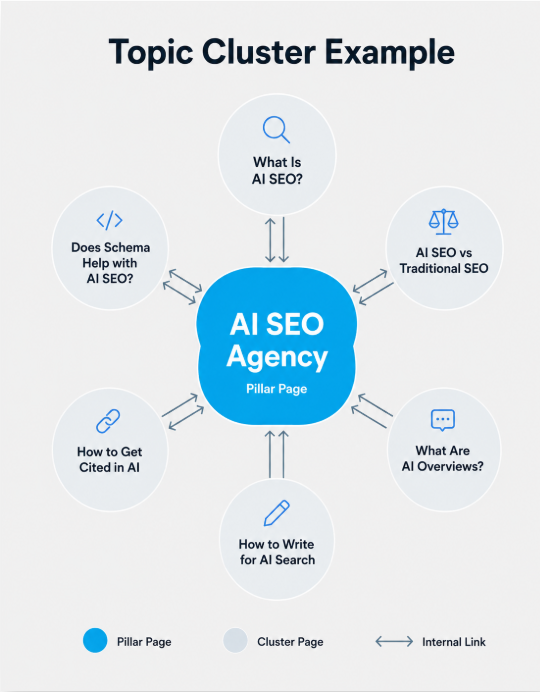
Our own AI SEO content is a good example of how this works in practice. Rather than creating articles around slightly different keyword variations, we have built the cluster around the different questions people have as they learn about and evaluate AI SEO.
At the centre of the cluster is our AI SEO Agency pillar page, which covers the broader service and connects the different parts of the topic. Supporting it are more focused resources covering what AI SEO is, AI SEO vs traditional SEO, AI Overviews, writing for AI-led search, technical requirements, tools, measurement, citations, schema and ecommerce visibility.
Each page has its own purpose. Someone trying to understand AI SEO and traditional SEO is looking for something quite different from someone trying to work out why their brand is not being cited in AI-generated answers.
The individual pages can perform on their own, but together they support the wider pillar page and create much stronger coverage of the subject. That is the idea behind a useful topic cluster: one central resource supported by connected pages that answer the more specific questions around it.
How Many Articles Do You Need?
There is no magic number. You do not suddenly build topical authority after 10, 25 or 100 articles.
A narrow service may only need a handful of strong supporting pages. A broad field such as finance or SEO may need dozens. The right number depends on topic complexity, search intent, competitor depth and what your audience actually needs.
Completeness matters much more than hitting an arbitrary publishing target.
Common Mistakes
Publishing Lots of Thin Pages
Volume on its own does not demonstrate expertise. Fifty weak pages can create more problems than five strong ones.
Chasing Unrelated Keywords
If your site publishes about anything with search volume, the subject focus becomes less clear and the content may stop supporting the business.
Ignoring Search Intent
Pages targeting almost identical searches can end up competing with each other.
Using AI to Mass-Produce a Cluster
AI can help with research and content planning, but dozens of generic articles with no original insight defeat the point.
Thinking Backlinks No Longer Matter
They still do. Strong subject coverage and a healthy backlink profile are not competing ideas.
How Do You Measure It?
Because there is no universal Google score, I would look at several indicators rather than one number:
- growth in relevant ranking queries
- search rankings across the cluster
- impressions and organic traffic
- links and referring domains
- brand mentions around the subject
- AI citations across relevant prompts
- competitor share of visibility
The important part is measuring the subject as a whole. The same principle applies when measuring AI SEO: one citation is interesting, but the trend across your important topics tells you much more.
Topical Authority Summarised
Topical authority is not about publishing as much content as possible. It comes from covering the right subject properly.
That means understanding what the audience needs, filling genuine content gaps, creating pages for different search intents and connecting them in a way that makes sense.
It is also not a replacement for the rest of SEO. Technical foundations, backlinks, content quality and site structure still matter. Strong clusters work best when those things are already in place.
As search becomes more answer-led, a well-built subject area gives search engines and newer AI systems a clearer picture of what your website knows.
If your website has plenty of content but it still feels disconnected, eCBD can help map the gaps, organise the structure and build a clearer AI SEO strategy around the subjects that actually matter to your business.
Frequently Asked Questions
What Is Topical Authority in SEO?
It describes how strongly a website demonstrates expertise and relevance around a particular subject. It usually comes from strong topic coverage, useful content and clear relationships between pages.
How Do You Build Topical Authority?
Start by defining the subject, mapping important subtopics and creating useful pages for different search intents. Connect those pages properly, add genuine expertise and keep the wider cluster updated.
What Is Topical Authority vs Domain Authority?
The first is specific to a subject, while domain authority generally describes the overall strength of a website and is often heavily influenced by links.
Is Topical Authority a Google Ranking Factor?
Not as a simple universal score or standalone ranking factor. Google uses many page-level and site-wide signals, while its specifically named topic-authority system is documented for news and specialised news queries.
How Many Articles Do You Need?
There is no set number. It depends on the complexity of the subject, existing coverage, search intent and what the audience actually needs.
Does Topical Authority Help AI Search?
Strong topic coverage can support AI visibility by giving systems more useful, connected source material across related questions. It does not guarantee citations, but it can strengthen the wider context around a subject.
