
What is AI SEO and How to Optimise for AI Search
The term can mean two slightly different things. Sometimes people use it to describe using AI tools to support SEO work, such as keyword research, content planning, metadata drafting, and on-page improvements. Increasingly, though, it is being used to describe optimising content for visibility in AI-driven search experiences like AI Overviews, AI Mode, ChatGPT, and Perplexity.
Both meanings matter. But if you want to stay visible as search evolves, the second one matters most. Strong SEO is still the foundation, but it now needs to support visibility in a world where answers are often generated before a user clicks through to a website.
Key takeaways
- AI search engine optimisation usually refers to improving your visibility in AI-driven search experiences like AI Overviews, but also in Large Language Models (LLMs) like ChatGPT, Claude, and Perplexity.
- It can also refer to using AI tools to make SEO workflows faster and more efficient.
- Traditional SEO focuses on rankings and clicks. AI search optimisation focuses more on mentions, citations, and inclusion in AI-generated answers.
- AI is changing SEO, but it is not replacing SEO. The fundamentals still matter.
- Helpful content, strong structure, internal linking, topical authority, and trust signals all still play an important role.
What is AI search engine optimisation?
AI search engine optimisation is the practice of improving your content so it can be found, understood, cited, and surfaced in AI-driven search experiences. That includes platforms and features such as Google AI Overviews, AI Mode, ChatGPT, Perplexity, and other answer-led interfaces.
Some people also use the term to describe using AI to support SEO tasks like research, drafting, and optimisation. In practice, both ideas are connected: AI can help you do SEO more efficiently, and your SEO strategy now also needs to account for how AI systems discover and present information.
In traditional SEO, the goal is to rank your page in search results so users click through to your site. In AI search, the goal expands. Your content may still drive a click, but it may also be used as a source, cited in an answer, summarised by an AI system, or influence the recommendation a user sees first.
That means AI search engine optimisation is not just about title tags and keyword placement. It is also about making your content clear, structured, trustworthy, and easy for AI systems to interpret. If search is becoming more answer-led, then your content needs to be answer-ready.
You will also see related terms such as AI SEO, AI search optimisation, generative engine optimisation (GEO), and answer engine optimisation or AEO. They overlap heavily. The exact label matters less than the practical outcome: helping your business show up across both traditional search and AI-driven discovery.
How AI search engines work compared with traditional search engines
One of the biggest reasons businesses get confused about AI search engine optimisation is that AI search does not always work like traditional search.
Traditional search engines such as Google and Bing are built around crawling, indexing, and ranking. They discover webpages, store information about them in an index, and then rank those pages for relevant queries.
AI search engines and AI search features often work differently. They do not just return a ranked list of pages. They typically retrieve relevant sources, synthesise an answer, and then cite or reference supporting sources. In other words, the user may see the answer first and the list of sources second.
That does not mean AI search ignores crawling or indexing altogether. Google’s AI features still rely on Google Search, which means crawlability, indexability, and snippet eligibility still matter. But the way visibility appears to the user is different. In traditional search, your page is the result. In AI search, your content may become part of the answer.
| Factor | Traditional search engines | AI search engines and AI search features |
|---|---|---|
| How they discover content | Primarily through crawling and indexing webpages | May rely on their own crawlers, underlying search indexes, third-party search providers, or retrieved web sources |
| What the user sees first | A ranked list of search results | A generated answer, summary, or recommendation layer |
| Main output | Clickable blue links with titles and snippets | Synthesised answers with citations, mentions, or supporting links |
| Main visibility goal | Rank high enough to win the click | Be selected, cited, summarised, or recommended in the answer |
| How content is used | Shown as an individual result | Often broken into pieces, interpreted, compared, and combined into an answer |
| Role of crawling | Core part of discovery and indexing | Still important, but not always the only discovery method behind the answer layer |
| Role of citations | Indirect, through ranking and clicks | Direct, because answers often include cited or linked sources |
| User journey | Search, compare results, click a page | Ask, read answer, then click only if more detail or validation is needed |
| Primary success metric | Rankings, clicks, traffic, conversions | Citations, mentions, answer visibility, assisted discovery, and higher-intent visits |
Do AI search engines crawl websites?
Sometimes yes, but not always in the same way traditional search engines do.
This is where the topic needs nuance. Google AI Overviews and AI Mode sit on top of Google Search, so they still depend on Google’s underlying search systems, indexed pages, and snippet eligibility. That means your normal SEO foundations still matter.
Other AI search experiences can work more like retrieval systems. They may query the web live, rely on search partners, use their own crawler access, or combine several methods before generating a response. What matters for businesses is not whether every AI platform has the same crawl model. What matters is that AI systems usually do not present the user with a simple ranked index in the old way. They retrieve useful source material, interpret it, and then present an answer layer that may include citations.
That is why AI search engine optimisation is not just about ranking pages. It is also about making your content easier to retrieve, interpret, trust, and cite.
Why citations matter more in AI search
In traditional search, being visible usually means your page ranks and the user clicks it. In AI search, visibility can happen even without an immediate click.
For example, if someone asks an AI system, “What should a small business look for in an SEO agency?”, the system may generate a summary and cite several supporting sources. If your content is one of those sources, your brand can influence the decision before the user ever visits your website.
That is one of the biggest differences between traditional SEO and AI search engine optimisation. You are no longer optimising only for page-level rankings. You are also optimising for answer inclusion, citation visibility, brand mentions, and being part of the source set the AI trusts enough to use.
A real example of how traditional search and AI search differ
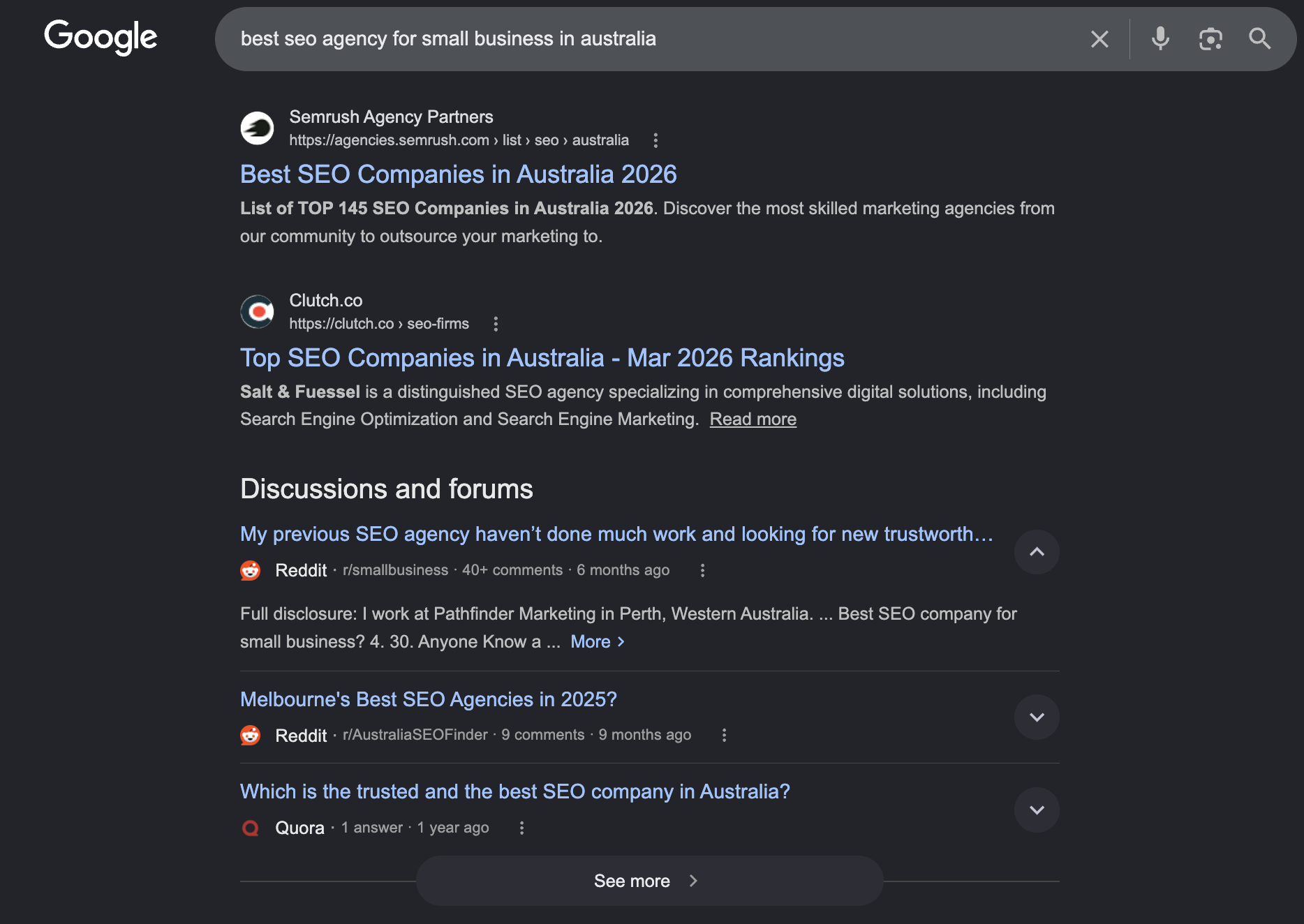
Imagine someone searches for “best SEO agency for small business in Australia”.
In traditional search, Google shows a list of agency pages, listicles, review pages, user forums, and directories. The user compares titles, descriptions, and rankings, then chooses which result to click.
In an AI search environment, the user may instead see a generated summary explaining what small businesses should look for, common pricing considerations, warning signs to avoid, and a shortlist of agencies or source pages that support the answer. The answer may cite a few websites directly, even if those pages are not all ranked in exactly the same order the user would see in a standard SERP.
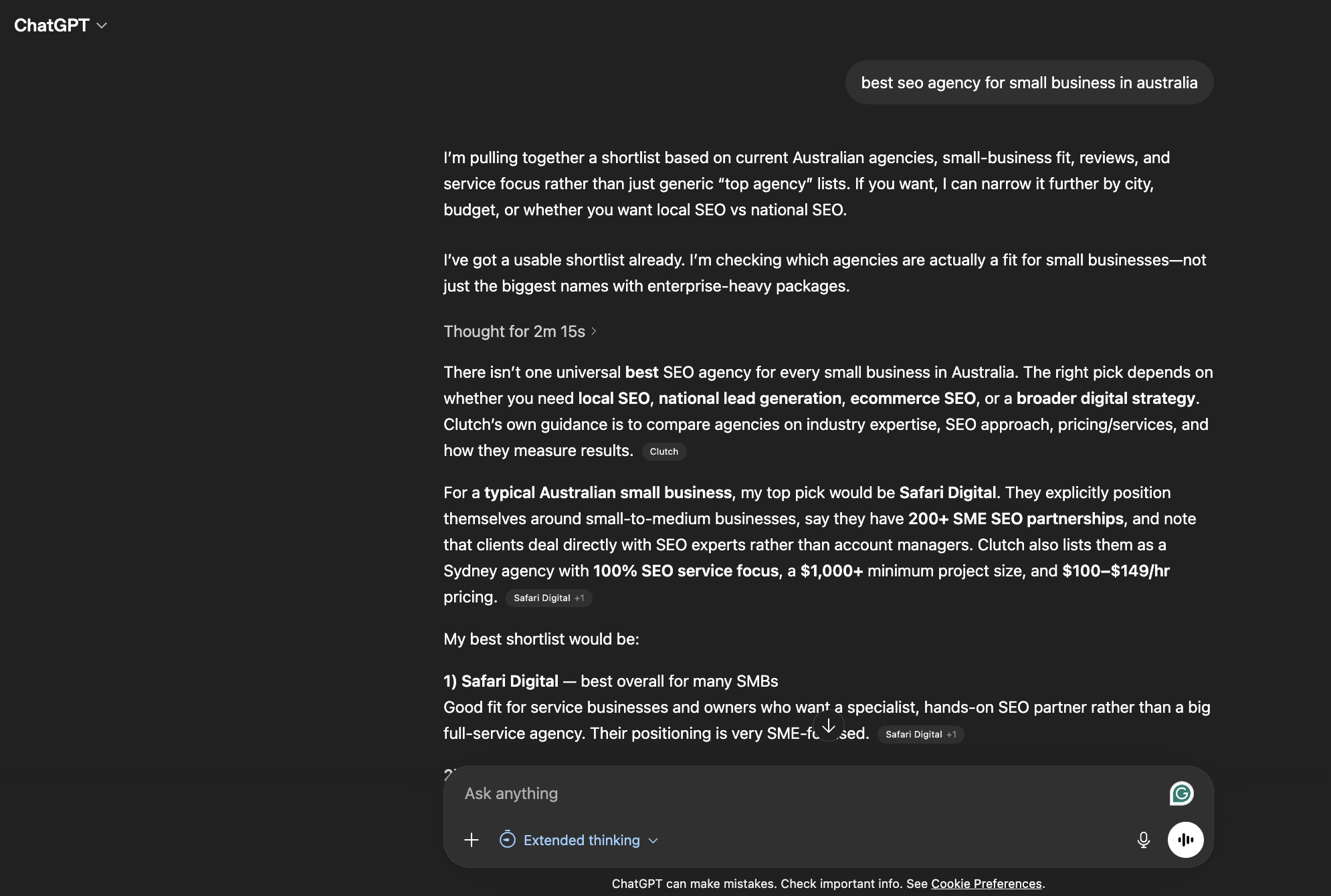
That is why AI search engine optimisation needs a broader mindset. You still want rankings, but you also want your content to be clear enough, trustworthy enough, and useful enough to be cited in the answer itself.
What AI search engine optimisation actually means in practice
If traditional SEO is about improving your visibility in search results, AI search engine optimisation is about improving your visibility in search-generated answers.
In practice, that means:
- writing clearer direct answers near the top of the page
- using headings that match real questions users ask
- building topic clusters instead of isolated blog posts
- making important content easy to crawl, index, and understand
- adding specific examples, comparisons, and practical detail
- strengthening trust signals so your content looks credible enough to cite
- thinking beyond rankings alone and considering mentions, citations, and answer visibility
That is also why weak, vague content struggles in AI search. If your page says the same generic things every other article says, without examples or depth, there is less reason for an AI system to rely on it.
How to make your content more citation-worthy for AI search
Use direct definitions
If the heading asks a question, answer it in the first sentence under that heading. AI systems and users both respond better when the answer comes early.
Add examples
Examples make content easier to understand and easier to summarise. They also help distinguish your page from generic competitor content.
Use tables and comparison blocks
Comparison tables help clarify complex topics and make relationships easier to parse. That is useful for readers and useful for answer extraction.
Show specificity
General statements are easy to ignore. Specific claims, clear scenarios, concrete recommendations, and practical frameworks are more useful.
Support claims with visible trust signals
Clear branding, service relevance, author transparency, internal links to related pages, and current supporting content all make your site look more dependable.
A simpler way to explain AI search engine optimisation
Traditional search engines crawl and rank pages.
AI search engines and AI search features often retrieve, interpret, and cite pages.
That is why AI search engine optimisation is not only about getting indexed. It is also about becoming the kind of source an AI system is willing to use in its answer.
Why AI search engine optimisation matters now
It matters because people are changing how they search.
Users are asking more specific, conversational, multi-part questions. They expect faster answers. They are increasingly happy to get a summary first and only click through when they need more detail. That changes how discovery works online.
For businesses, this creates both risk and opportunity. Some informational pages may see fewer clicks if users get enough of an answer directly in the search experience. At the same time, businesses that create clear, authoritative, well-structured content have more opportunities to become part of those answers.
In other words, the brands that adapt early are not just chasing rankings. They are building content that can be selected, summarised, cited, and trusted.
How to optimise for AI search engine visibility
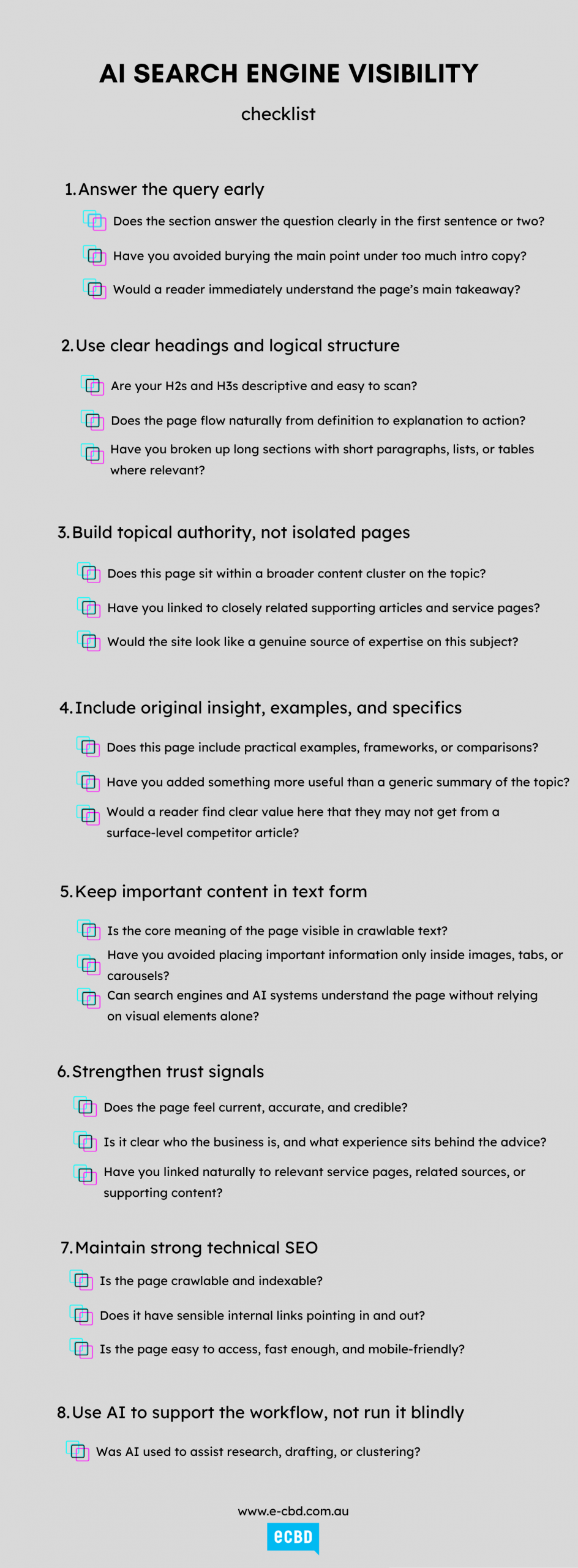
1. Answer the query early
Do not bury the answer. Start important sections with a direct response to the question the heading implies. AI systems and users both respond well to content that gets to the point quickly.
For example, if your heading is “What is AI search engine optimisation?”, the first sentence under it should define the term clearly. You can add nuance afterwards, but the answer should come first.
2. Use clear headings and logical structure
Well-structured content is easier to read, easier to scan, and easier for AI systems to interpret. Use clear H2s and H3s, short paragraphs, lists, tables where relevant, and natural sequencing from definition to explanation to action.
A page with messy blocks of text and no obvious hierarchy is harder to parse. A page with descriptive headings and strong flow is easier to understand and more likely to support answer extraction and citation.
3. Build topical authority, not isolated pages
One decent article is rarely enough. AI search engine optimisation works best when your website covers a topic properly across multiple connected pages.
For example, if you want to own visibility around AI search, it helps to have connected content such as:
- what are AI Overviews
- GEO vs SEO
- how to optimise for AI search
That kind of cluster builds depth, supports internal linking, and makes your expertise easier to understand.
4. Include original insight, examples, and specifics
Generic content is easy to ignore. Content with clear examples, specific recommendations, original observations, and practical detail is more useful to both users and AI systems.
If you explain the same point every other blog is making, in almost the same words, there is less reason for your content to stand out. If you add a useful framework, a comparison table, a real example, or a more nuanced explanation, your page becomes more citation-worthy and more memorable.
5. Keep important content in text form
Important information should not live only inside images, carousels, tabs, or design elements that hide the meaning of the page. AI systems and search engines still depend on accessible, crawlable text content.
You can support that text with visuals, screenshots, diagrams, and videos, but the main message of the page should still be visible in the written content.
6. Strengthen trust signals
Pages that look credible are easier to trust. That means using accurate claims, keeping content current, showing who is behind the content, and making sure your site feels consistent and reliable.
For service businesses, trust signals also include a clear brand presence, strong service pages, internal links to relevant supporting content, and messaging that shows real experience rather than generic AI-style filler.
7. Maintain strong technical SEO
AI search optimisation does not replace technical SEO. Your pages still need to be crawlable, indexable, internally linked, and easy to access. A technically weak site creates friction before any content optimisation even begins.
Good technical foundations make it easier for search engines to process your pages and easier for AI search features to surface supporting content from your site.
8. Use AI to support the workflow, not run it blindly
AI can help you move faster, but it should support a better process rather than shortcut it. Use AI for research, drafting, clustering, and iteration. Then refine the output with human editing, fact-checking, search intent refinement, and stronger examples.
The strongest AI-assisted SEO content usually combines machine speed with human judgment.
What AI search engine optimisation includes in practice
For most businesses, AI search engine optimisation is not one isolated task. It is a mix of strategy, content improvement, and workflow support.
In practice, it often includes:
- AI-assisted keyword research and topical clustering
- content planning around answer-led search intent
- writing and refining direct-answer content
- refreshing old articles for clarity and AI-search relevance
- strengthening internal linking across related pages
- improving entity signals and topical depth
- building service and blog content that is easier to cite and summarise
- reviewing visibility shifts across traditional search and AI-driven discovery
That is why it makes sense to think of AI search engine optimisation as both a content discipline and a visibility discipline. It influences how you create content, how you structure it, and how you assess whether it is performing in modern search environments.
How success is measured in AI search optimisation
Traditional SEO often focuses on rankings, impressions, clicks, sessions, leads, and conversions. Those still matter. But AI search optimisation adds another layer.
Now you also need to think about:
- whether your brand is being cited or mentioned in AI answers
- whether your content is visible in AI search experiences
- whether users are discovering your brand earlier in the decision journey
- whether branded search and assisted discovery are increasing
That does not mean every business needs advanced AI visibility tooling on day one. But it does mean rankings alone are no longer the full story. Modern search visibility is broader than classic rankings.
A simple example of AI search engine optimisation in practice
Imagine a business that offers SEO services in Australia and publishes an article targeting AI search engine optimisation.
A traditional SEO approach might focus on ranking the page for the keyword, building internal links to it, and improving the metadata and heading structure. That still matters.
An AI search optimisation approach would do more. It would make sure the article answers the question clearly, includes practical examples, connects to related topics like AI Overviews and GEO vs SEO, reflects real expertise, and is structured in a way that makes it easier for AI systems to summarise and cite.
That is the difference. The first approach tries to win the ranking. The second tries to win the ranking and the answer layer.
What businesses should do now
If your business has done nothing around AI search yet, do not overcomplicate the first step. Start by reviewing your most important informational and mid-funnel content.
Ask:
- Does this page answer the topic clearly?
- Does it get to the point early?
- Is it better structured than competing pages?
- Does it connect naturally to related pages on the site?
- Does it add anything original or useful beyond the basics?
- Would an AI system find it easy to summarise and trust?
Then build from there. Strengthen internal links. Improve topic coverage. Refresh thin pages. Use AI where it helps, but keep quality control human. That is usually a far better path than chasing shortcuts or publishing large volumes of weak AI-generated copy.
A practical way to think about AI search engine optimisation
You do not need to treat this as a completely separate world from SEO.
- Traditional SEO helps people find your website in search results.
- AI-assisted SEO helps your team work more efficiently.
- AI search engine optimisation helps your content stay visible in answer-led search experiences.
That is why the most resilient strategy is not old SEO versus new AI tactics. It is a connected strategy that strengthens your content, structure, and visibility across both.
Need help with AI search engine optimisation?
Search is changing quickly, but the answer is not to chase hype or publish more low-value content. It is to build stronger SEO foundations, improve how your content is structured, and create pages that can perform in both traditional search and AI-driven discovery.
At eCBD, we help businesses strengthen their SEO strategy, improve topical coverage, organise stronger internal linking, and create content that is clearer, more useful, and better aligned with how modern search now works.
If you want help improving your visibility across traditional search, AI Overviews, and emerging AI search experiences, get in touch with eCBD.
FAQs
What is AI search engine optimisation?
AI search engine optimisation is the practice of improving content so it can be found, understood, cited, and surfaced in AI-driven search experiences like Google AI Overviews, AI Mode, ChatGPT Search, and Perplexity. It can also refer to using AI tools to support SEO work.
Can AI do search engine optimization?
Yes, AI can help with many SEO tasks such as keyword research, content outlines, metadata drafting, and workflow support. But it still needs human oversight for strategy, accuracy, brand voice, and quality control.
What is the 30% rule in AI?
The 30% rule in AI is not a formal SEO rule. It is commonly used as a shorthand idea that AI should support part of the work, while humans still provide judgement, editing, creativity, and accountability.
Is SEO being replaced by AI?
No. AI is changing how search works, but SEO is not being replaced. Strong SEO fundamentals still matter, and they now need to support visibility across both traditional and AI-driven search environments.
Is ChatGPT good for SEO?
ChatGPT can be useful for SEO when used as a support tool for research, outlining, drafting, and idea generation. It is not a substitute for strategy, expertise, or editorial review.
How is AI search optimisation different from traditional SEO?
Traditional SEO focuses on rankings and clicks from search engine results pages. AI search optimisation focuses more on citations, mentions, and inclusion in AI-generated answers and summaries.
Do I need special technical work for AI search engine optimisation?
Not usually. The foundations are still strong SEO basics: crawlable pages, indexable content, internal linking, clear structure, and useful text content.
Do businesses need AI search engine optimisation now?
If your business depends on search visibility, educational content, or research-stage discovery, yes. Even if you start small, it is worth adapting your content strategy now so you are not relying only on old search behaviour.
