AI SEO vs Traditional SEO: Is AI SEO Replacing Traditional SEO?
AI SEO hasn’t replaced traditional SEO. It has expanded what search visibility looks like. Traditional SEO still helps your pages get crawled, understood and ranked in search engines, while AI SEO adds another goal: making your business and content easier to surface, cite and recommend across AI Overviews, ChatGPT, Gemini, Perplexity and other AI-driven search experiences.
Key Takeaways
- Traditional SEO still matters. Crawlability, useful content, internal linking, authority and technical health remain fundamental.
- AI SEO adds visibility inside generated answers, citations, mentions and recommendations.
- The biggest change is not that keywords disappear. Search behaviour becomes more conversational and answer-led.
- AI search places more emphasis on clear, extractable information, entity understanding and evidence that supports what your business claims.
- Traditional SEO and AI SEO need different measurement because an AI mention doesn’t always produce an immediate click.
- Most businesses do not need two completely separate strategies. AI SEO works best as an additional layer on top of strong SEO foundations.
AI SEO vs Traditional SEO: What’s the Main Difference?
Traditional Search Engine Optimisation focuses primarily on helping webpages appear prominently in organic search results.
AI SEO broadens the target.
You still want your pages to rank, but you also want your information and brand to be understood well enough to appear inside AI-generated answers.
That could mean:
- a website being cited as a source
- a brand being mentioned in a recommendation
- information being summarised in an answer
- a page appearing as a supporting link
- the business being included when an AI system compares providers
The important distinction is that traditional search usually presents results for the user to choose from. AI search may produce the answer first and then provide sources or supporting links.
AI SEO vs Traditional SEO at a Glance
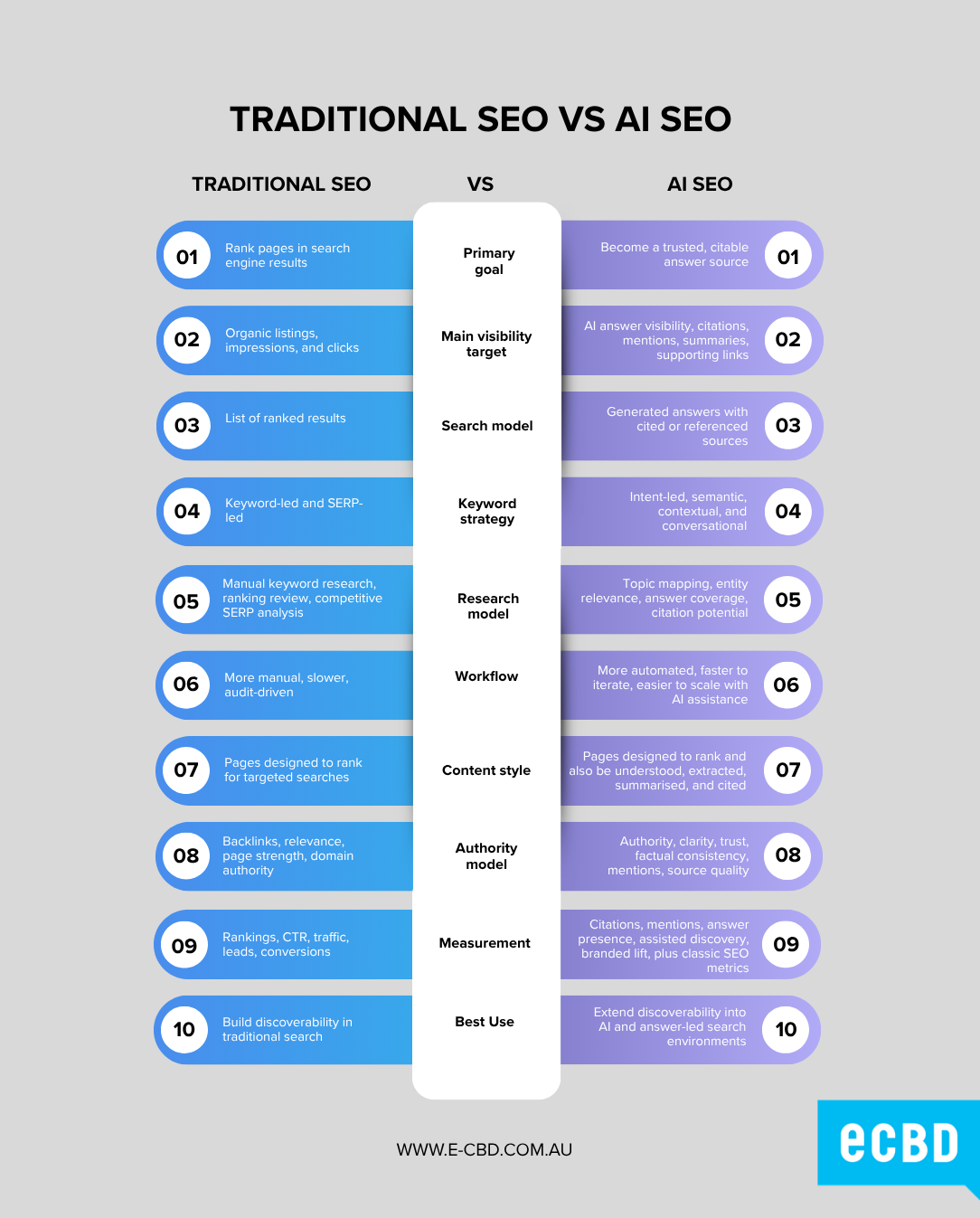
| Area | Traditional SEO | AI SEO |
|---|---|---|
| Main goal | Earn rankings and organic traffic | Earn AI answer visibility alongside rankings |
| Primary environment | Google, Bing and classic search results | AI Overviews, AI Mode, ChatGPT, Gemini, Perplexity and other AI search |
| User journey | User chooses between ranked pages | User may receive a generated answer before clicking |
| Research | Keywords, SERPs and search intent | Keywords plus prompts, follow-up questions, entities and topic coverage |
| Content | Useful pages that satisfy search intent | The same, with additional focus on clear answers and extractable information |
| Authority | Relevant links, reputation and topical strength | Authority plus brand/entity consistency and wider mentions |
| Measurement | Rankings, impressions, clicks, traffic and conversions | Those metrics plus citations, mentions, answer presence and AI share of voice |
Does Traditional SEO Still Matter After AI Search?
Yes.
For Google specifically, traditional SEO fundamentals remain directly relevant to AI features such as AI Overviews and AI Mode.
Your pages still need to be crawlable and indexable. Google still needs to understand what the page is about, and useful content, site structure, internal links and technical quality still matter.
In other words, AI search hasn’t created a completely separate internet.
Strong technical SEO still gives search systems access to the pages and information you’ve created.
The difference is that the information may now be presented to the user in more ways than a traditional ranked result.
What Actually Changes With AI SEO?
1. Search Becomes More Conversational
Traditional keyword research often starts with relatively short searches such as:
- SEO agency Gold Coast
- best CRM software
- building inspection cost
People can ask AI systems much more detailed questions in one go.
For example:
Which type of SEO agency is best for a Gold Coast business with an established website but declining organic leads, and what should I look for before choosing one?
The underlying intent isn’t completely new. The way the question is expressed is.
AI SEO therefore looks beyond individual keywords and considers the wider set of questions, comparisons and follow-up needs around a topic.
2. Being the Answer Matters Alongside Ranking
Traditional SEO usually asks:
How can this page rank for the right searches?
AI SEO adds another question:
Is the useful information clear enough for an AI system to understand and incorporate into an answer?
That encourages stronger definitions, direct explanations, useful comparison tables and self-contained sections that still make sense when viewed outside the full article.
This doesn’t mean writing robotic snippets for machines. It generally means getting to the point faster.
3. Brand Understanding Becomes More Important
A webpage isn’t the only information available about a business.
AI systems may encounter your brand across your own website, directories, reviews, industry publications, media coverage and other third-party sources.
That makes consistency important.
Your website should make it clear:
- who the business is
- what it does
- where it operates
- what it has expertise in
- why its information should be trusted
Good traditional SEO already supports much of this. AI search simply gives brand and entity clarity another reason to matter.
4. Search Visibility Isn’t Always a Click Anymore
Traditional SEO measurement usually follows a fairly familiar path:
impression → ranking → click → session → conversion.
AI discovery can be messier.
A user may see your company mentioned in an AI-generated answer and then:
- click a citation
- continue asking questions
- search for your brand later
- visit directly at another time
- remember your business when they’re ready to buy
This is why AI visibility needs additional measurement rather than replacing your existing SEO reporting.
How Does AI SEO Change Keyword Research?
Keywords still matter.
The change is that they are no longer the only useful way to model demand.
Traditional SEO research might examine search volume, ranking difficulty, existing SERPs and the search intent behind a phrase.
AI SEO adds things such as:
- natural-language prompts
- follow-up questions
- comparisons
- problem-led searches
- entities and their relationships
- questions that may not have meaningful traditional keyword volume
The goal is to understand the complete information need rather than writing a separate page for every wording variation.
How Does Content Change for AI SEO?
Most of what makes content good for AI search also makes it better for people.
Useful AI-ready content tends to:
- answer the main question early
- use descriptive headings
- keep individual sections focused
- include useful examples
- make comparisons easy to understand
- support claims with evidence where possible
- avoid unnecessary filler
- show genuine expertise rather than repeating generic information
That is why AI search optimisation is less about creating a completely different type of content and more about making existing SEO content clearer, more useful and easier to interpret.
Do You Need Special Technical SEO for AI Search?
Not in the way some marketing around AI SEO suggests.
There is no magic “AI schema” that guarantees citations.
For Google AI Overviews and AI Mode, the same basic technical requirements used for Search continue to apply.
Important information should be available in accessible text, pages should be internally linked and content should be crawlable and indexable.
Structured data can still help systems understand specific information where an appropriate schema type exists, but it should accurately reflect visible page content rather than being treated as an AI shortcut.
How Does Authority Differ in AI SEO?
Traditional SEO has long looked at signals such as links, relevance, reputation and topical authority.
Those haven’t stopped mattering.
AI search adds more attention to the wider information environment around a brand.
Relevant third-party brand mentions, consistent information and genuine expertise can all help reinforce what your business is associated with.
This is part of the overlap between GEO and SEO: the website still matters enormously, but visibility increasingly extends beyond whether one specific page holds one specific ranking.
How Do You Measure AI SEO vs Traditional SEO?
| Traditional SEO | Additional AI SEO Measurement |
|---|---|
| Keyword rankings | Prompt visibility |
| Search impressions | AI answer presence |
| Organic clicks | Citations and supporting links |
| Organic sessions | AI referral traffic |
| Organic share of voice | AI share of voice |
| Leads and revenue | Assisted and downstream conversions |
Traditional metrics don’t become irrelevant.
They simply don’t describe every type of visibility anymore.
Does AI SEO Mean Using AI to Do SEO?
Sometimes people use “AI SEO” to describe two different things.
One meaning is optimising for AI search visibility, which is what this article is mainly about.
The other is using AI tools to make SEO work faster.
AI can support tasks such as:
- research
- keyword clustering
- content gap analysis
- outline development
- metadata ideas
- data analysis
- internal-link suggestions
But automation doesn’t remove the need for strategy.
Producing ten times more generic content isn’t an SEO advantage simply because software made it faster.
Human input is still important for commercial priorities, brand voice, fact-checking, original insights and deciding which recommendations are actually worth implementing.
Is AI Content Better for SEO?
No.
AI-generated content isn’t automatically better or worse simply because AI was involved in producing it.
The useful question is whether the finished page is accurate, original enough to add value and genuinely helpful to the person reading it.
AI can make content production faster. It can also make it very easy to produce a lot of repetitive material nobody needed.
The editing and judgement still matter.
Do You Need Both AI SEO and Traditional SEO?
For most businesses investing seriously in search, yes, but I wouldn’t treat them as two completely independent programs.
If the website has major crawling issues, weak service pages and very little useful content, solve those problems before obsessing over ChatGPT citations.
If traditional SEO is already performing well, then looking at AI visibility, citation gaps and how your brand appears across newer search surfaces becomes much more useful.
Think of it as layers:
- Build a technically sound and useful website.
- Earn traditional search visibility.
- Make important content clear and answer-ready.
- Understand how the brand appears across AI search.
- Address genuine citation and visibility gaps.
That’s much more practical than throwing away a working SEO strategy because a new acronym appeared.
Is AI Search Replacing Traditional SEO?
No.
AI search is changing how information is presented and how people research, but traditional SEO remains fundamental to discoverability.
For Google’s AI features specifically, the company itself continues to recommend established SEO best practices.
The better way to think about it is that SEO now has more surfaces to account for.
Your website may need to perform in:
- traditional organic results
- Google AI Overviews
- AI Mode
- ChatGPT
- Gemini
- Perplexity
- other answer-led environments
The fundamentals haven’t vanished. The visibility opportunity has expanded.
What Should Businesses Do Now?
Don’t abandon SEO and don’t chase every AI search tactic you hear about.
Start with your actual gaps.
- Fix technical SEO problems.
- Improve weak commercial pages.
- Build genuinely useful topical coverage.
- Answer important customer questions clearly.
- Strengthen internal linking.
- Make expertise and business information easy to verify.
- Measure whether your brand is being surfaced in relevant AI answers.
If your organic visibility is already strong but competitors are consistently being cited or recommended where you aren’t, that’s when more deliberate AI SEO work makes sense.
eCBD’s AI SEO approach starts with the same principle: understand the existing search foundation first, then work out which AI visibility gaps actually matter to the business.
If you need some clarity on whether you have an SEO problem, an AI visibility problem or both, get in touch and we can look at where the gaps actually are.
Frequently Asked Questions
What Is the Difference Between AI SEO and Traditional SEO?
Traditional SEO focuses primarily on earning visibility in search engine results. AI SEO extends that work into AI-generated search experiences, where success may also mean being cited, mentioned, summarised or recommended inside an answer.
Does Traditional SEO Still Matter After AI Search?
Yes. Traditional SEO fundamentals such as crawlability, indexation, useful content, internal linking, technical quality and authority continue to support visibility in both conventional search and AI-powered search experiences.
Is AI SEO Better Than Traditional SEO?
They aren’t really substitutes. Traditional SEO creates the foundation, while AI SEO addresses additional visibility opportunities in AI-driven search. A business with weak SEO fundamentals generally has more to gain by fixing those first.
Will AI Search Replace Traditional SEO?
No. AI search changes the search interface and creates new ways for content to be discovered, but search engines still need accessible, useful source material. SEO is evolving to cover more visibility surfaces rather than disappearing.
Is AI-Generated Content Better for SEO?
Not automatically. AI can improve efficiency, but the finished content still needs to be accurate, useful, specific and worth reading. Generating more content doesn’t create value if the pages simply repeat what already exists.
Do I Need a Separate AI SEO Strategy?
You may need additional AI visibility work, but it usually shouldn’t be disconnected from traditional SEO. For most businesses, the sensible approach is to maintain one search strategy that covers both organic rankings and relevant AI search opportunities.
