GEO vs SEO
GEO and SEO focus on different ways of being discovered online. SEO helps webpages earn visibility in traditional search results, while GEO helps brands and content appear, get cited or be mentioned in AI-generated answers. In practice, they overlap heavily, and most businesses do not need to choose one or the other.
Key Takeaways
- SEO focuses on organic visibility in traditional search engines such as Google and Bing.
- GEO, or Generative Engine Optimisation, focuses on visibility inside AI-generated answers.
- AEO focuses more specifically on direct-answer experiences such as featured snippets, People Also Ask and AI Overviews.
- SEO remains an important foundation because generative engines still depend on accessible, useful and trustworthy web content.
- GEO adds more emphasis on content quality, content structure, brand mentions, entity clarity and visibility across AI platforms.
- Most businesses should strengthen SEO first, then extend that work into GEO rather than treating them as separate strategies.
What Is the Difference Between GEO and SEO?
The simplest difference is where you are trying to earn visibility.
SEO, or Search Engine Optimisation, helps your website rank in traditional search engine results pages. The usual goal is to appear prominently enough that someone clicks through to your website.
GEO, or Generative Engine Optimisation, focuses on improving the likelihood that your content or brand appears inside answers created by generative AI.
That may mean being cited as a source, mentioned by name, summarised in an answer or included as one of several recommended options across AI platforms such as ChatGPT, Gemini, Perplexity or Microsoft Copilot.
The US spelling, Generative Engine Optimization, refers to the same thing.
One does not replace the other. Strong SEO gives search engines and AI systems useful source material to work with. GEO adds another layer by considering how easily that information can be understood, extracted and used inside AI-driven search.
What Is GEO in Digital Marketing?
In digital marketing, GEO is the practice of improving how clearly generative engines can understand your content, expertise and brand.
The goal is not simply to rank a webpage. It is to improve visibility in generated responses.
That could include:
- citations to your website
- brand mentions
- recommendations
- summaries of your content
- supporting links
- inclusion in AI-generated comparisons
This is why AI search engine optimisation is becoming part of wider search strategy. Discovery now happens across traditional search engines, Google AI Overviews and dedicated AI tools.
What Is SEO?
SEO is the process of improving a website so search engines can crawl it, understand it and rank relevant pages for useful searches.
SEO strategies can include:
- technical SEO
- keyword and search intent research
- on-page optimisation
- content development
- internal linking
- website architecture
- local SEO
- backlink profiles and wider authority
- conversion and user experience improvements
The aim is not simply more organic traffic. Good SEO should attract the right visitors and support enquiries, leads, bookings or sales.
You may also see the US spelling Search Engine Optimization. Again, it means the same thing.
Where Does AEO Fit In?
AEO stands for Answer Engine Optimisation.
The terminology is not completely standardised, but it is useful to think of AEO as the direct-answer layer of search.
AEO focuses on structuring information so it can answer a question clearly and quickly in places such as:
- featured snippets
- People Also Ask
- voice search
- Google AI Overviews
- other answer-first search experiences
GEO is broader because generative AI can combine information from several sources before creating a new response.
In practice, many of the same improvements support both AEO and GEO: clear headings, concise definitions, useful tables, good content structure and direct answers.
SEO vs AEO vs GEO
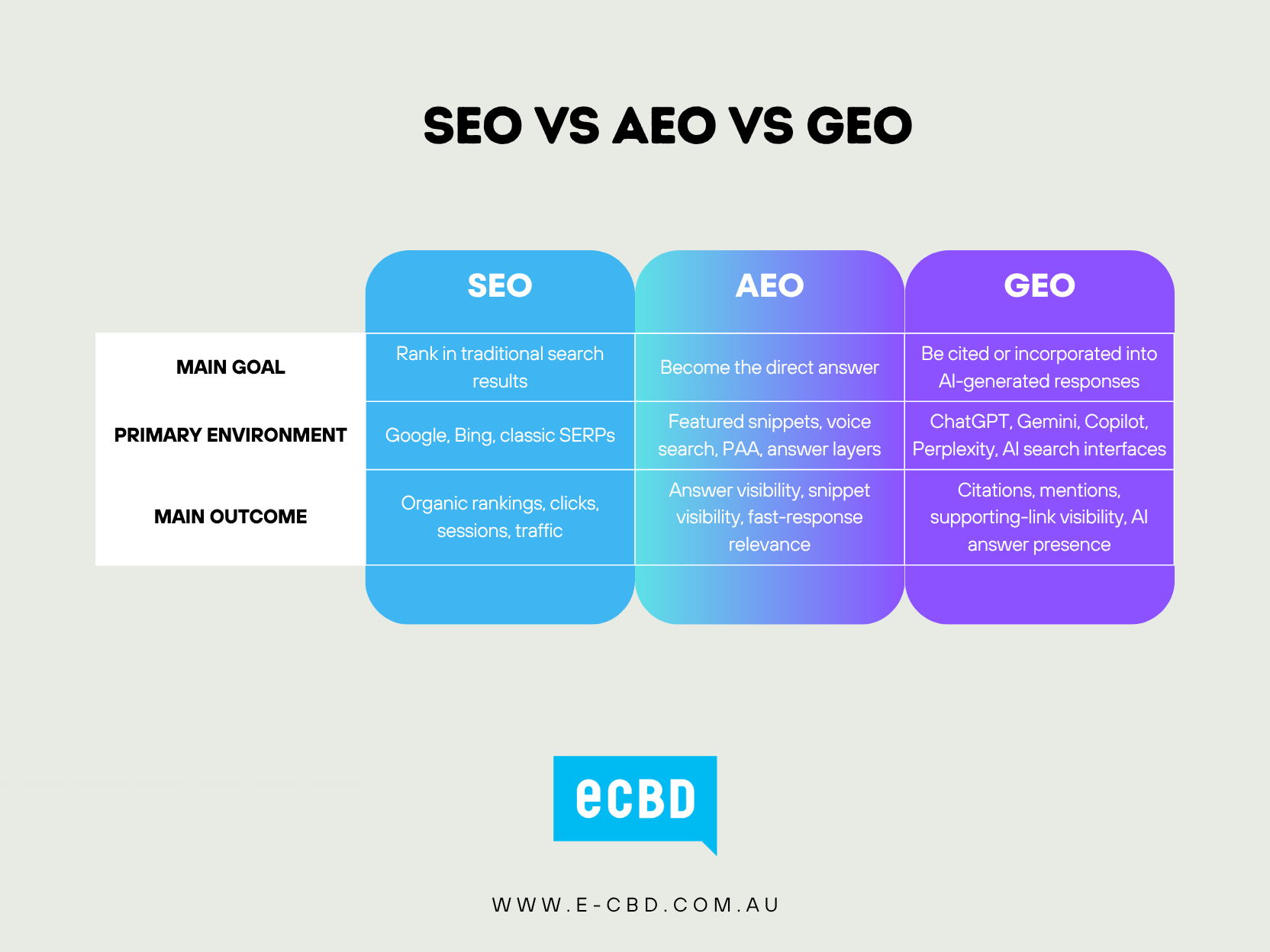
| Approach | Main goal | Where visibility happens | Typical outcome |
|---|---|---|---|
| SEO | Rank relevant webpages | Google, Bing and other search engines | Rankings, clicks, organic traffic and conversions |
| AEO | Provide a direct answer | Featured snippets, PAA and answer-led surfaces | Answer visibility and snippet inclusion |
| GEO | Earn visibility in generated answers | ChatGPT, Gemini, Copilot, Perplexity and other AI platforms | Citations, mentions and recommendation visibility |
They are not three completely separate digital marketing disciplines. They are different visibility outcomes supported by many of the same foundations.
GEO vs SEO: The Main Differences
SEO Competes for Rankings; GEO Competes for Inclusion
With SEO, a page competes for a position among other search results. The user sees the results and decides which one to click.
With GEO, the AI system may research several sources and generate the answer itself. Your website may be cited, your business may be mentioned, or information from your content may contribute to the answer.
That changes what a visibility win looks like.
SEO Is More Page-Led; GEO Can Be More Brand-Led
Traditional SEO is often built around individual pages and search intent.
GEO can involve a wider range of signals because AI systems may encounter information about your business through reviews, directories, industry sites, comparison pages, forums and media coverage.
For a local business, even consistent information across your website and Google Business Profile can help reinforce what the business is, where it operates and what it does.
This is why brand mentions matter. GEO is not only about changing the wording on your own website.
GEO Places More Pressure on Content Quality and Structure
Good SEO content has always needed to be useful and relevant, but generative AI places even more value on information that is easy to interpret and summarise.
That means paying attention to:
- clear definitions
- descriptive headings
- direct answers
- comparison tables
- specific examples
- original data or insight
- factual precision
- strong content structure
This is one reason writing for AI search tends to work best when it is also good writing for people. The answer should not be buried under unnecessary filler.
SEO and GEO Need Different Measurement
Traditional SEO reporting is relatively mature.
Google Search Console can show impressions, clicks and query performance, while analytics platforms help track organic traffic, landing pages and conversions.
GEO adds another measurement layer, including:
- AI citation frequency
- brand mentions
- prompt visibility
- answer presence
- AI share of voice
- supporting-link appearances
- AI referral traffic
A GEO win does not always produce an immediate click. Someone might see your company mentioned in an AI answer, remember the name and search for it later.
Do You Need GEO or SEO, or Both?
For most established businesses, the answer is both, but not necessarily in equal amounts.
If your website has technical problems, weak service pages, little useful content and poor search visibility, a standalone GEO campaign is probably not where we would start.
Fix the foundation first.
If traditional SEO is already reasonably strong and your customers are using AI tools to research providers, compare services or ask detailed questions, then GEO deserves more attention.
This tends to matter sooner for:
- B2B businesses
- SaaS companies
- professional services
- agencies and consultants
- ecommerce brands with comparison-led buying journeys
- businesses where customers research extensively before making contact
If you are unsure whether the bigger opportunity is SEO, GEO or a combination of both, we can help you identify where the actual visibility gap sits.
What Does GEO Work Actually Involve?
GEO is not simply adding more FAQs or using AI tools to rewrite existing pages.
Depending on the website, it can involve:
- strengthening important SEO landing pages
- improving topical coverage
- building connected content clusters
- making expertise and authorship easier to verify
- improving brand and entity consistency
- earning relevant mentions from third-party sources
- adding useful examples, evidence and original information
- monitoring AI visibility across important prompts
Our approach to AI SEO strategy builds on traditional SEO rather than separating the two, because most GEO opportunities still depend on having a strong website underneath them.
Do Structured Data and Schema Markup Help GEO?
Structured data and Schema markup can help search engines understand information on a page more clearly, particularly where established schema types apply.
They are useful technical signals, but they are not a shortcut to AI citations.
There is no special GEO schema that guarantees inclusion in AI-generated answers, and adding more markup does not compensate for weak content quality or unclear information.
Use structured data where it accurately describes the visible content and makes sense for the page.
Does Domain Authority Matter for GEO?
Authority still matters, but it needs some nuance.
Third-party SEO tools use metrics such as domain authority to estimate the relative strength of websites and backlink profiles. Google does not use a metric called Domain Authority as a ranking factor.
For GEO, the broader idea of authority is more useful than the score itself.
AI systems are more likely to trust information when a business has strong supporting signals across its website and the wider web: relevant mentions, credible links, consistent information, useful content and demonstrated expertise.
Do AI Systems Use Training Data or Live Web Sources?
Both can matter, depending on the AI platform and the type of query.
Large language models are built using training data, but many modern AI search experiences also retrieve current information from the web when answering questions.
That is why GEO should not be treated as trying to somehow “optimise the training data”.
The practical opportunity is to publish clear, accessible, useful information that AI-driven search systems can find and confidently use when current web retrieval is involved.
How to Optimise for GEO Without Neglecting SEO
Keep Technical SEO Strong
Your important pages still need to be crawlable, indexable and internally linked. Strong technical SEO helps both traditional search engines and AI search systems access the information you publish.
Answer Important Questions Clearly
Use headings that match real questions and answer them early. Add more depth underneath where it genuinely helps.
Create Something Worth Citing
Generic content is easy to produce. Give search engines and AI systems a reason to use yours.
Useful additions include real examples, original research, clear comparisons, practical frameworks and first-hand experience.
Build Topical Depth
One page rarely demonstrates everything a business knows about a topic.
Connected clusters supported by sensible internal linking make it easier to understand the relationship between your content.
Think Beyond Your Own Website
Your website matters, but so does the wider information available about your brand.
Relevant reviews, directories, industry mentions, media coverage and trusted third-party references can strengthen the overall picture AI systems see.
Do Not Chase GEO Hacks
You do not need a separate AI version of your website.
You do not need to abandon traditional SEO.
And you do not need to add Schema markup or awkward FAQs everywhere simply because someone claims AI prefers them.
The fundamentals of optimising for AI search are much less dramatic: stronger answers, useful information, clear structure, evidence, technical accessibility and visible expertise.
What Should Businesses Focus on First?
Start with the weakness rather than the acronym.
If your website barely ranks, improve your SEO foundations.
If you already rank but your content is vague or generic, improve the content.
If traditional search visibility is healthy but competitors are consistently being surfaced across Google AI Overviews, ChatGPT, Gemini or Microsoft Copilot and you are not, investigate the GEO gap.
If you do not know whether you appear in AI search at all, measure it before deciding how much work it needs.
GEO and SEO Work Better Together
Search is changing, but businesses do not need three disconnected strategies for SEO, AEO and GEO.
SEO helps your pages earn visibility in search results. AEO helps your information work in direct-answer experiences. GEO extends that visibility into generative AI and AI-generated answers.
The strongest approach is to connect them.
At eCBD, that means starting with solid search foundations and then working out where AI visibility creates an additional opportunity rather than chasing every new acronym.
If you want clarity on what your website should focus on next, get in touch and we can help you work out where the real gaps are.
Frequently Asked Questions
What Is the Difference Between GEO and SEO?
SEO focuses on earning visibility and rankings in traditional search results. GEO focuses on helping a brand or its content appear inside AI-generated answers through citations, mentions, summaries or recommendations.
What Is GEO in Digital Marketing?
GEO stands for Generative Engine Optimisation. It means improving your content, brand signals and digital presence so generative AI systems can understand and potentially use or cite your information in generated responses.
What Is the Difference Between AEO and GEO?
AEO generally focuses on direct-answer visibility, while GEO is broader and focuses on inclusion in generative AI responses. The terminology overlaps, and there is no universally agreed definition separating the two.
Do Structured Data and Schema Markup Improve GEO?
They can help systems understand page information, but they do not guarantee AI visibility or citations. Structured data should accurately describe the page rather than being added purely for GEO.
How Do You Measure GEO Compared With SEO?
SEO commonly uses rankings, impressions, clicks, organic traffic and conversions. GEO adds metrics such as citations, brand mentions, prompt visibility, answer presence, AI share of voice and AI referral traffic.
Will GEO Replace SEO?
No. GEO depends heavily on the same foundations that support SEO: accessible websites, useful content, authority, internal linking and clear information. It expands search visibility rather than replacing traditional SEO.
