
What Is a Zero-Click Search?
One of the biggest shifts in modern search engine optimisation is that visibility and traffic are no longer moving in perfect alignment. Many websites are seeing impressions increase while clicks level off or decline. If you are still measuring SEO success mainly through click volume, that can make performance look confusing.
A major reason for this is the rise of zero-click search. In a zero-click search, the user gets the answer directly on the search engine results page and never clicks through to a website. This can happen through Knowledge panels, People Also Ask, local packs, video carousels, Shopping Results, a Direct Answer Box, and now increasingly through AI Overviews and other forms of AI search.
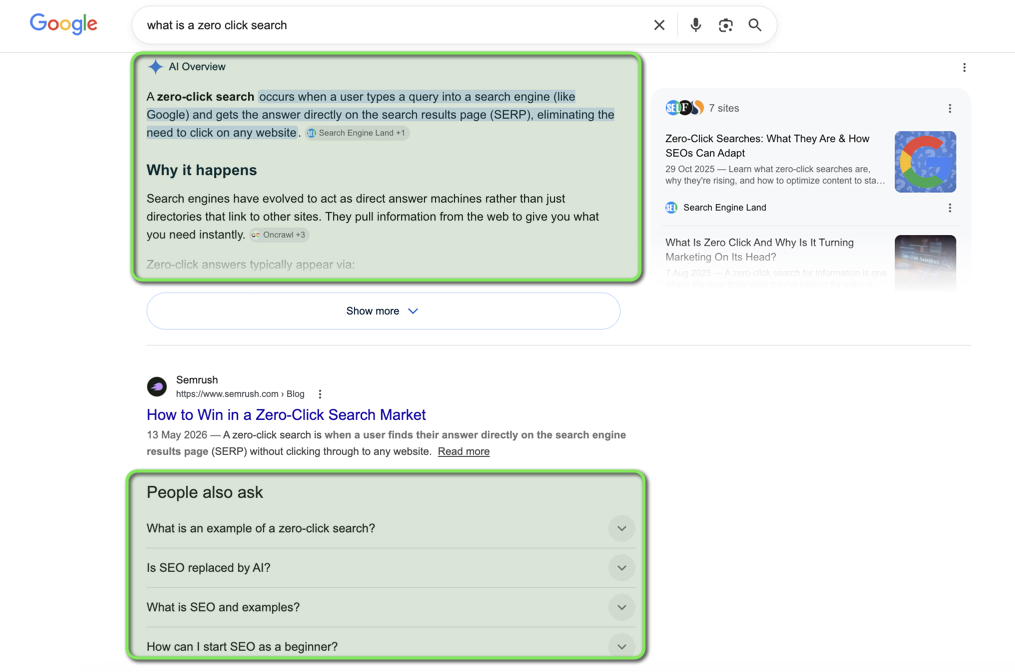
This does not mean SEO is over. It means the search landscape is changing. Brands now need to think about brand visibility, brand recognition, authority, mention-worthiness and strategic click value, not just raw organic traffic. In this guide, we’ll explain what a zero-click search is, why zero-click searches are increasing, how they affect SEO, and how to adapt your SEO strategies so your business stays visible and commercially relevant even when fewer users click.
Key Takeaways
- A zero-click search happens when the answer appears directly in the SERP and the user does not click through.
- AI Overviews, Knowledge panels, People Also Ask, local packs and Direct Answer Box features are common causes of Zero-Click Searches.
- Zero-click searches can reduce click-through rate, even when impressions and visibility rise.
- This does not mean SEO is dead, but it does mean SEO reporting and content strategy need to evolve.
- Brands can still benefit by optimising for visibility, authority, structured content, mention-worthiness and high-intent clicks.
What Is a Zero-Click Search?
A zero-click search is a search where the user gets the information they need directly from the search engine results pages without visiting a website. In simple terms, the search engine solves the query before the click happens.
This is the core zero click search meaning: the answer is delivered on the SERP itself. The user sees the information, gets what they need and continues their user journey without opening a traditional organic result.
This matters because SEO teams often still think in terms of “rankings = clicks”. In a world of Zero-Click Searches, that is no longer always true. A page or brand may be contributing strongly to visibility and influence without receiving the click itself.
It also matters because this is happening across both traditional search engines and newer AI-led environments. A modern user query may be answered by a Knowledge panel, a local pack, or a generative summary created by Google AI or other AI search engines.
What Causes Zero-Click Searches?
Zero-click searches are caused by SERP features that answer or partially answer the query directly on the search engine results page.
The most common causes include:
- AI Overviews that generate summarised answers from multiple sources
- Knowledge panels and knowledge graphs that present entity information directly
- People Also Ask modules, including PAA boxes and the broader PAA box experience
- local packs, Local Pack Results and map pack style displays
- video carousels and image blocks
- Shopping Results
- Direct Answer Box style features for fast factual queries
These features are all part of the wider move toward a more compressed search experience. Instead of “search → click → scan → answer”, the experience becomes “search → answer”.
Why Are Zero-Click Searches Increasing?
Zero-click searches are increasing because the direction of modern search is toward speed, convenience and immediate answers.
Users want faster answers
Most users do not search because they want to visit a website. They search because they want an answer. If the search engine can provide that answer instantly, many users will not click unless they need more depth or want to take action.
Search behaviour is shifting
Search behaviour has shifted toward quick-answer experiences. That is particularly true for informational queries, definitions, comparisons, local intent searches and top-of-funnel discovery.
AI Overviews and generative AI are accelerating it
AI Overviews and zero-click searches are closely linked. Generative AI, generative summaries and answer-led interfaces make it easier for Google Search to satisfy the user query directly. This is one reasons terms like GEO (Generative Engine Optimisation) became important in SEO discussions, even as the labels themselves evolved.
Search engines are improving semantic search
Search engines are getting better at understanding user intent, entities and relationships through semantic search, machine learning and natural language processing. That makes it easier for them to turn web content into immediate answers.
Are Zero-Click Searches Bad for SEO?
Not always. They can reduce traffic, but they do not automatically make SEO less valuable.
Yes, they can reduce clicks
This is the most obvious downside. A zero-click result can answer the question before the visit happens, which means fewer sessions and a lower click-through rate for some queries.
They can weaken traffic-only reporting
If your SEO reports only track rankings and traffic, zero-click features can make performance look worse than it really is. A page may be visible, influential and repeatedly surfaced, but still receive fewer clicks than it once did.
They can still create business value
Zero-click visibility can still support brand visibility, brand recognition, trust and later-stage demand. A user may see your brand in a SERP feature, remember it, and come back later through a branded search or a more commercial query.
They affect intent types differently
Zero-click searches usually hit informational queries hardest. For higher-intent searches, especially where the user needs to compare services, read details, contact a provider or view a landing page, clicks still matter a great deal.

So no, zero-click search does not mean SEO is broken. It means the way SEO creates value is broadening.
Examples of Zero-Click Searches
Some of the clearest zero click search examples include:
- a local business query answered through Google Maps, a Google Business Profile or Google My Business data
- a branded query answered by Knowledge panels and the Google Knowledge Graph
- a simple question answered in PAA boxes
- a product query answered in Shopping Results
- an informational search summarised through AI Overviews
This is why zero click searches are not one feature. They are the result of a broader set of SERP features and changing search behaviours.
How Zero-Click Search Changes SEO Strategy
Zero-click search changes SEO strategy because it forces businesses to think beyond click volume alone.
Move beyond traffic-only KPIs
If impressions are rising while clicks fall, that does not always mean your SEO strategies are failing. It may mean your visibility is rising in a more answer-led SERP environment. Metrics need to expand beyond sessions alone.
Optimise for visibility as well as clicks
Some search appearances are still valuable even when they do not produce a direct click. This is especially true for top-of-funnel visibility, informational discovery and entity-level brand reinforcement.
Focus more on brand mentions and topical authority
In AI-led and feature-rich SERPs, source reputation matters more. If your site is treated as a useful source, repeated brand mentions can help reinforce authority even before a click happens.
Structure content to be featured, not just ranked
Content now needs to work both as a destination page and as source material for SERP features and AI summaries. That makes content formatting, direct answers and strong subheadings more important.
Prioritise higher-intent clicks
If some top-of-funnel traffic is lost to zero-click results, the remaining strategic opportunity often shifts toward more valuable clicks lower in the customer journey.
How to Optimise for Zero-Click Search
If zero-click search is now part of the search environment, the goal is not to fight it. The goal is to adapt.
Answer the question directly
Pages that answer the main query clearly and early are more likely to be surfaced in Direct Answer Box features and AI summaries.
Use strong H2 and H3 structure
Good headings help both users and systems understand the page. Clear hierarchy also improves extractability in AI-powered search.
Use stronger content formatting
Content formatting matters. Lists, tables, FAQs, short definition-led paragraphs and clearly segmented sections are easier to feature and easier to summarise.
Build FAQ and question-led content
FAQ sections and question-led writing support People Also Ask visibility and broader answer extraction. They also help cover follow-up questions tied to the original search intent.
Use Structured Data and schema markup
Structured Data and schema markup help search engines classify and understand content more clearly. They do not guarantee a feature, but they support clarity, eligibility and richer interpretation.
Support Rich Results where relevant
In some cases, correct schema implementation can help a page become eligible for Rich Results. Historically, marketers have also used tools like the Google Structured Data Testing Tool, though today broader validation workflows are more common.
Strengthen E-E-A-T and trust
In a world of summarised answers, trust matters more. Strong authorship, source credibility, case examples and topical authority. All these EEAT factors help improve the likelihood that your content will be surfaced and cited.
Optimise for local SEO where relevant
Local SEO matters because many zero-click journeys happen through map-based and local result features. Strong Google Business Profile data, clear Local Business Listings and local relevance all support local feature ownership.
Zero-Click Search and AI Overviews
AI Overviews are one of the clearest modern examples of Zero-Click Searches. They synthesise information from multiple web pages and present a direct answer without requiring the user to click through in the traditional way.
This creates a more complex SEO picture:
- visibility can rise while CTR falls
- brand exposure can increase without a site visit
- being cited still has value
- content now works as both destination and source material
This is one reason modern SEO increasingly overlaps with AI SEO, answer-first content and wider AI marketing strategy.
It also means businesses should pay attention not just to Google AI, but to the broader rise of AI search engines, ChatGPT Search, large language model interfaces and other forms of artificial intelligence-driven discovery.
What Should Marketers Measure in a Zero-Click Environment?
This is one of the biggest gaps in how many teams still report SEO. If zero-click search is growing, then marketers need better visibility metrics.
Useful metrics to track include:
- impressions in Google Search Console
- click-through rate trends
- ownership of SERP features
- appearance in AI-driven search experiences
- brand mentions in summaries and visible answer blocks
- assisted conversions and branded search lift
- visibility by query type and intent stage
Google Search Console is particularly useful here because it can show whether a page is gaining visibility while losing clicks. That pattern is often one of the clearest signs that zero-click search is affecting the query.
When Zero-Click Visibility Is Still Valuable
Not every impression without a click is wasted.
Zero-click visibility can still be valuable when it:
- builds brand awareness
- improves brand recognition
- strengthens topical authority
- influences later branded searches
- supports future high-intent clicks
- increases your share of voice across the SERP
This is especially true for early-stage discovery and top-of-funnel visibility, where the user may not be ready to click immediately but still forms a strong impression of the brand.
A Practical Zero-Click SEO Checklist
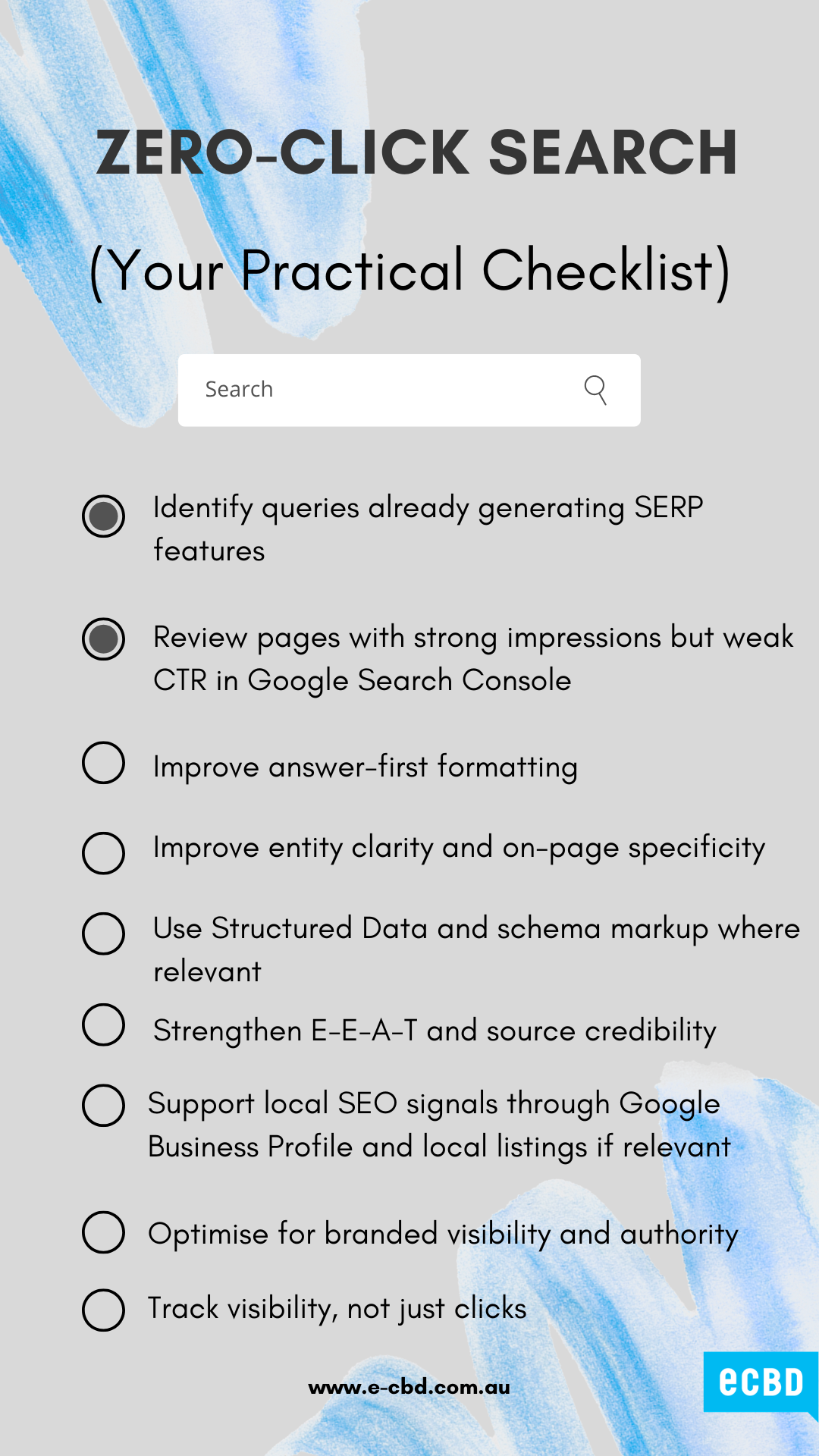
- Identify queries already generating SERP features
- Review pages with strong impressions but weak CTR in Google Search Console
- Improve answer-first formatting
- Add FAQ and snippet-friendly sections
- Improve entity clarity and on-page specificity
- Use Structured Data and schema markup where relevant
- Strengthen E-E-A-T and source credibility
- Support local SEO signals through Google Business Profile and local listings if relevant
- Optimise for branded visibility and authority
- Track visibility, not just clicks
What Content Still Works in a Zero-Click Search World?
As zero-click searches become more common, not all content types are affected in the same way. Generic informational blog posts are often the most exposed because Google, AI Overviews and other answer engines can summarise simple definitions or basic advice directly in the search results. However, this does not mean content marketing is no longer valuable. It means the strongest content needs to give users something they cannot easily get from a short AI-generated answer.
A useful way to think about this comes from research and analysis shared by Cyrus Shepard at Zyppy, who outlined different types of content that are more likely to survive Google’s zero-click era. The common theme is that stronger content usually has a clear moat: it is original, experience-based, brand-led, community-driven, transaction-focused or useful enough that users still want to visit the website directly.
| Content Type | Why It Can Survive Zero-Click Search | Strength | Effort | Best Use |
|---|---|---|---|---|
| Owned Audience Content | Builds a direct relationship with users through channels like email, newsletters, communities or memberships, reducing reliance on Google clicks. | Very Strong | Very High | Brand building, loyalty and repeat engagement |
| Transaction Pages | Users still need to complete actions such as booking, buying, enquiring, comparing options or signing up. | Very Strong | High | Product, service, booking and lead-generation pages |
| Original Research | Unique data, studies, surveys and proprietary insights are harder for AI to replace and more likely to earn citations. | Strong | High | Industry reports, data studies and thought leadership |
| Community & UGC Content | Real conversations, first-hand experiences and niche discussions provide context that AI summaries often cannot fully replicate. | Strong | High | Forums, customer communities and discussion hubs |
| Creator-Led Content | Audiences follow the person, brand voice or format, not just the topic. This makes the content more memorable and searchable by name. | Strong | High | Video, podcasts, expert commentary and brand personalities |
| In-Depth Reviews & Tests | First-hand testing, photos, comparisons, examples and real product experience give users more confidence than a short summary. | Strong | High | Product reviews, comparisons and buyer research |
| Brand & Trust Pages | Pages such as About, editorial policy, reviews, team bios and case studies help search engines and users understand who the business is. | Strong | Low to Medium | Entity building, E-E-A-T and trust signals |
| Tools & Calculators | Interactive content gives users a reason to visit because it helps them solve a specific problem based on their own inputs. | Moderate to Strong | High | Cost calculators, quote tools, checklists and assessments |
| Directories & Databases | Structured, searchable and regularly updated information can remain valuable when it helps users compare or filter options. | Moderate | High | Resource hubs, comparison databases and niche directories |
| Expert Perspective | Opinion, interpretation and professional judgement are harder to summarise than basic facts, especially when backed by real experience. | Moderate | Medium | Analysis, commentary and expert-led articles |
| Templates | Downloadable or reusable assets help users complete a task, making the page more practical than a standard blog post. | Moderate | Medium | Brief templates, planning documents, spreadsheets and checklists |
| Case Studies | Real results, client examples and before-and-after context support trust and conversion, even if they do not always drive large traffic volumes. | Moderate | Medium | Service pages, sales enablement and proof of results |
| Original Reporting | Fast, exclusive or in-depth reporting can still attract attention because it provides information not available elsewhere. | Moderate | High | News, industry updates and exclusive insights |
| Support & Documentation | Help content, product documentation and troubleshooting pages remain useful because users need clear, accurate instructions from the source. | Moderate | Low to Medium | Support hubs, product docs and customer education |
| Guides & Explainers | Basic explainers are more vulnerable, but they can still work when they include unique examples, expert insight, visuals or brand-specific context. | Weak to Moderate | Medium | Educational content and topic hubs |
| FAQs & Glossaries | Simple definitions are easy for AI to summarise, but they can still support internal linking, topical authority and answer extraction. | Weak | Low | FAQ sections, glossary hubs and quick-answer content |
| Lists & Roundups | Generic listicles are at higher risk, but curated, well-evidenced and niche-specific lists can still be valuable when they include clear reasoning. | Weak to Moderate | Low to Medium | Comparison content, curated resources and buying guides |
The takeaway is not that businesses should stop creating informational content. Instead, they need to make that content more useful, more original and more connected to real business value. In a zero-click search environment, the content most likely to perform is content that builds trust, demonstrates experience, helps users make decisions or gives them a practical reason to visit the website.
Closing Thoughts
Zero-click search does not mean SEO has stopped working. It means the search environment is changing, and success has to be measured more intelligently. Visibility, mention-worthiness, source authority and strategic click value now matter alongside raw traffic.
For many businesses, the real question is no longer just “how do we rank?” but “how do we stay visible, trustworthy and commercially useful in a SERP that increasingly answers the question before the click happens?” That takes stronger content, better structure, sharper reporting and a more modern SEO strategy.
Need help adapting to zero-click search?
If your impressions are rising but clicks are flattening, eCBD can help you build an SEO strategy that works in both traditional and zero-click search environments. From content structure and AI visibility to broader SEO strategy and Content Marketing support, we can help you turn search visibility into something more valuable than a simple click count. Start by getting in touch with us, so we can discuss your SEO needs.
Frequently Asked Questions
What is a zero-click search?
A zero-click search happens when the user gets the answer directly on the search engine results page and does not click through to a website. This can happen through SERP features such as local packs and AI Overviews.
Why are zero-click searches increasing?
They are increasing because search engines are getting better at giving users direct answers. AI Overviews, and other Google SERP features are making it easier to satisfy the query without a click.
Are zero-click searches bad for SEO?
Not always. They can reduce clicks, but they can also improve brand visibility and reinforce authority. The impact depends on the type of query, the stage of the customer journey and the business model.
What are examples of zero-click searches?
Examples include Knowledge panels, People Also Ask, local packs, Shopping Results, Direct Answer Box features and AI Overviews. In each case, the user can get useful information directly on the SERP.
How do AI Overviews affect zero-click search?
AI Overviews are a major modern zero-click feature. They can reduce clicks on informational searches while still increasing source visibility and brand exposure.
How do you optimise for zero-click search?
Use answer-first formatting, strong headings, FAQ sections, schema markup, structured content, strong E-E-A-T signals and better entity clarity. The goal is to make your content easier to feature, cite and trust.
Does zero-click search mean SEO is dying?
No. It means SEO is evolving. Brands now need to optimise for visibility, mentions, authority and high-intent clicks, not just raw traffic.
