GEO vs SEO
GEO vs SEO (and AEO): What’s the Difference?
Search is no longer just about ten blue links. People still use Google and Bing in the traditional way, but they also ask ChatGPT, Gemini, Copilot, Perplexity, and other AI systems to explain topics, compare providers, summarise options, and recommend next steps. That shift has created a new layer of search visibility, and with it, a new wave of terms: SEO, AEO, and GEO.
If you have been wondering about GEO vs SEO, what GEO in digital marketing actually means, whether GEO services are different from SEO services, or what a GEO dashboard is compared with an SEO dashboard, you are asking the same questions many marketers are asking right now.
The short version is this: SEO helps your website rank in traditional search results. AEO helps your content become the direct answer in answer-first experiences. GEO helps your content get cited, summarised, and surfaced in AI-generated responses. They are different, but they are deeply connected. The brands that will perform best are the ones that treat them as one connected search strategy, not three unrelated disciplines.
Key takeaways
- SEO focuses on organic visibility in traditional search engine results pages.
- AEO focuses on direct-answer visibility in featured snippets, voice search, People Also Ask, and answer-first search experiences.
- GEO focuses on being selected, cited, and summarised in AI-generated answers.
- SEO is still the foundation. GEO and AEO build on top of it.
- SEO usually aims to win rankings and clicks. GEO often aims to win citations, mentions, answer inclusion, and assisted discovery.
- Modern search is not SEO or GEO. It is SEO, AEO, and GEO working together.
SEO is about improving your visibility in traditional search engines like Google and Bing, where users choose from a list of ranked results. GEO, or Generative Engine Optimisation is about improving your visibility in AI-generated answers, where systems summarise information from multiple sources and may cite or recommend your brand inside the response.
In simple terms, SEO helps people find your website, while GEO helps AI systems understand and surface your content. The goal of SEO is often the click. The goal of GEO is often the citation, mention, or answer-layer visibility that leads to discovery.
What is GEO in digital marketing?
In digital marketing, GEO stands for Generative Engine Optimisation. It is the practice of improving content so generative AI systems can interpret it clearly, trust it, and use it in their responses.
Traditional search engines retrieve and rank webpages. Generative engines do something different: they assemble a response by combining information from multiple sources. That changes what visibility looks like. Instead of only trying to rank as a webpage, brands are now also trying to become part of the answer itself.
That is why GEO matters in digital marketing. It reflects the move from ranking-based discovery to answer-based discovery. When a user asks an AI system a question, the first impression may no longer be your meta title in a search result. It may be a generated answer that cites, summarises, or recommends your content.
What is SEO?
SEO, or Search Engine Optimisation, is the process of improving a website so it performs better in traditional search engines. It involves technical SEO, keyword targeting, content quality, internal linking, site structure, page experience, backlinks, and strong alignment with search intent.
The aim of SEO is to improve organic rankings, attract qualified traffic, and turn that traffic into business outcomes such as enquiries, leads, bookings, or sales. Traditional SEO still matters because users still search in the normal way, search engines still crawl and index content, and AI systems still rely on the open web as source material.
And What is AEO in this mix?
AEO stands for Answer Engine Optimisation. It sits between SEO and GEO and is one of the most useful bridge concepts in modern search. AEO is about making your content answer-ready, so it can be surfaced in featured snippets, voice results, People Also Ask boxes, AI Overviews, and other answer-led experiences.
If SEO is about ranking, and GEO is about being cited inside generated answers, then AEO is about making your content clear enough, direct enough, and structured enough to become the answer quickly.
This is why AEO matters so much in the GEO vs SEO conversation. A lot of the content changes that support GEO also support AEO: question-led headings, direct definitions, concise summaries, FAQ sections, comparison tables, step-by-step explanations, and content that answers real user questions without fluff.
SEO vs AEO vs GEO: what each one is trying to achieve
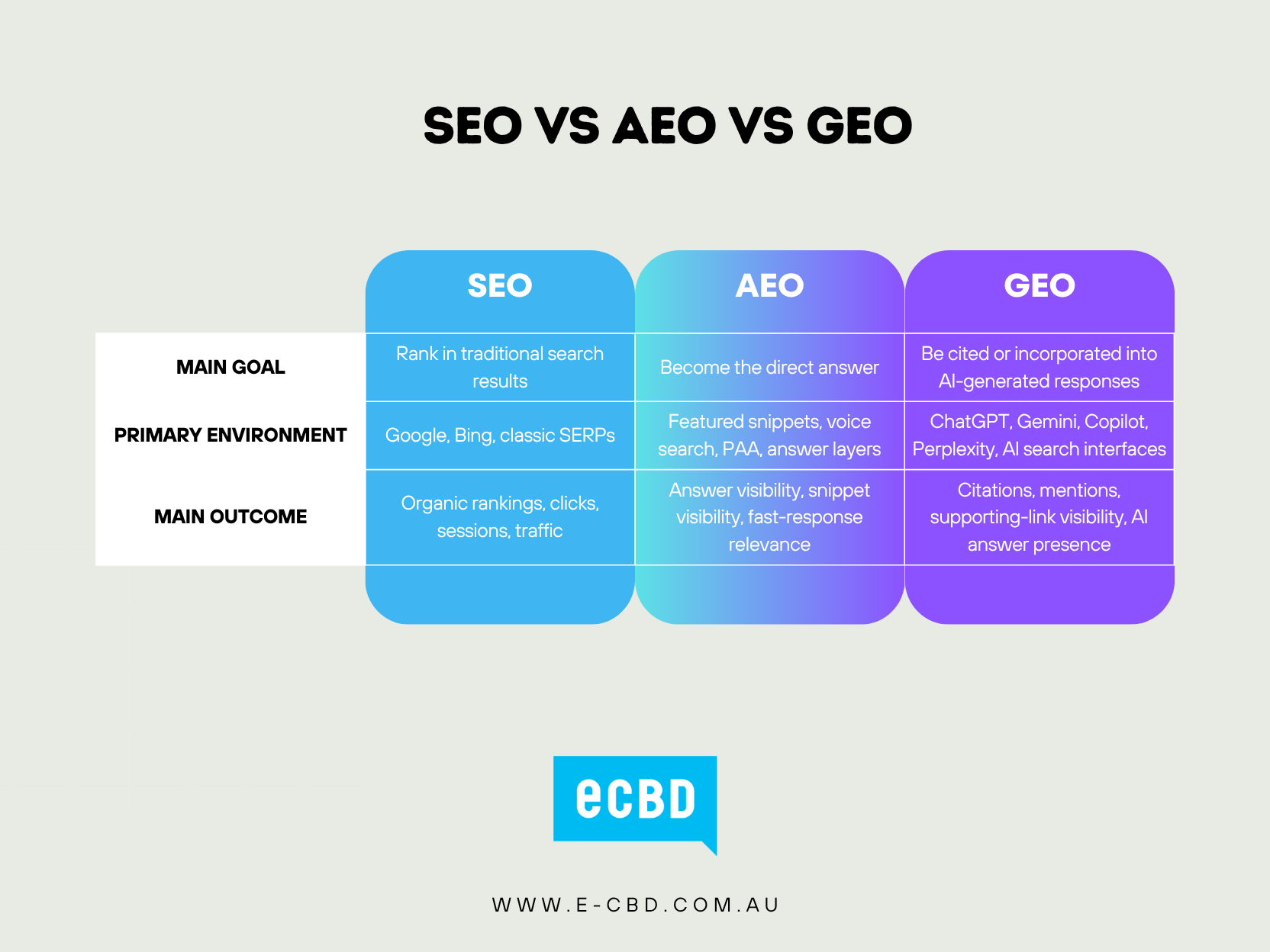
| Approach | Main goal | Primary environment | Main outcome |
|---|---|---|---|
| SEO | Rank in traditional search results | Google, Bing, classic SERPs | Organic rankings, clicks, sessions, traffic |
| AEO | Become the direct answer | Featured snippets, voice search, PAA, answer layers | Answer visibility, snippet visibility, fast-response relevance |
| GEO | Be cited or incorporated into AI-generated responses | ChatGPT, Gemini, Copilot, Perplexity, AI search interfaces | Citations, mentions, supporting-link visibility, AI answer presence |
This is the simplest way to understand the relationship. SEO drives visibility in ranked results. AEO improves direct answer delivery. GEO improves AI answer inclusion and citation visibility.
GEO vs SEO: what’s the difference?
The biggest difference between GEO and SEO is in how visibility is earned.
With traditional SEO, the objective is usually to rank high enough that the user clicks your result. With GEO, the objective is often to become part of the AI-generated answer itself. That answer may still lead to a click, but the first win is often a citation, a brand mention, a summarised explanation, or a recommendation.
This changes the shape of the search journey. In traditional search, the user compares a page of options. In generative search, the user may receive an answer first and only click later if they want to validate the information, explore deeper, or contact a provider. That means GEO is more closely connected to selection and citation, while SEO is more closely connected to ranking and click-through.
The difference between SEO and GEO can be summarised in one line: SEO optimises for rankings, GEO optimises for inclusion in generated answers.
SEO is built for search engines that return lists of links. GEO is built for generative engines that return answers. In SEO, your page appears as a result. In GEO, your content may appear as a source behind the result, a cited explanation, or part of the answer the user sees first.
This is also why GEO demands slightly different content qualities. Search engines reward relevance, crawlability, authority, and technical soundness. Generative engines still value those things, but they also place more pressure on clarity, factual precision, extractability, conversational language, and enough context for an AI system to summarise confidently.
Should You Look for Different Services Between SEO and GEO?
SEO services usually include technical SEO, keyword research, on-page optimisation, metadata, internal linking, content strategy, site architecture, backlinks, local SEO, and performance reporting.
GEO services are more focused on AI visibility. That can include improving answer clarity, restructuring content for summarisation, building topic clusters, reinforcing entities and brand positioning, strengthening trust signals, adding FAQ-style sections, and making content easier for AI systems to cite and interpret.
In practical terms, SEO services help a site become easier to rank. GEO services help content become easier to select, summarise, and cite. The best agencies do not treat those as separate silos. They treat GEO as an added layer built on top of strong SEO foundations.
Is There Any Difference Between SEO and GEO Tracking?
An SEO dashboard usually tracks rankings, impressions, click-through rate, sessions, conversions, backlinks, crawl health, and indexed pages. It is built to show how your website performs in traditional search.
A GEO dashboard is designed to show performance in AI search and answer-driven environments. Depending on the tools available, it may track citation frequency, answer presence, brand mentions in AI responses, prompt visibility, supporting-link appearances, AI share of voice, and downstream branded search lift.
That difference matters because traditional SEO reporting does not fully explain AI visibility. A page may be influential in generated answers without producing a classic click pattern. GEO dashboards try to make that new kind of visibility measurable.
A real example: how one query behaves in SEO, AEO, and GEO
Take a query like “best project management software for small teams”.
In a traditional SEO context, the goal is to rank a category page, comparison article, or product page so the user clicks through from Google. In an AEO context, the goal is to create a page that directly answers common follow-up questions such as “what features matter most for small teams?” or “which tools are easiest to use?” so the content is answer-ready for snippets or answer boxes.
In a GEO context, the goal is broader. You want your brand and content to be clear enough, specific enough, and trusted enough that an AI system can cite your comparison, summarise your evaluation criteria, or mention your product as one of the recommended options in a generated answer.
That is the difference in practice. One query, three visibility layers, and one connected strategy.
Another example: a service-based business
Imagine a user searches “building and pest inspection cost in Queensland”.
SEO aims to rank a well-optimised service or blog page. AEO aims to provide a clean, direct answer to the pricing question and related questions like what affects the cost or what is included in the inspection. GEO aims to make that same content useful enough for an AI system to summarise the pricing factors, explain the process, and cite the business as a trustworthy source.
This is where a lot of businesses miss the opportunity. They optimise for the ranking, but not for the answer. Or they write an answer, but not one with enough depth, specificity, and structure for AI systems to use confidently.
Why GEO is not replacing SEO
One of the biggest mistakes in the current conversation is treating GEO as a replacement for SEO. It is not.
AI systems still need source material. They still rely on webpages, site structure, textual content, internal linking, and clear information. If your site is weak technically, thin on content, or hard to understand, it is unlikely to perform strongly in either traditional search or AI-driven discovery.
This is why the smartest way to think about modern search is dual optimisation. SEO creates discoverable source material. AEO makes that material answer-ready. GEO improves the chance that the same material is used inside AI-generated answers.
Where GEO and SEO overlap
Although GEO and SEO are different, they overlap heavily in practice.
- Both depend on understanding user intent.
- Both reward content that is helpful, accurate, and easy to navigate.
- Both perform better when the site has strong internal linking and crawlable structure.
- Both benefit from strong topical coverage.
- Both rely on trust, clarity, and visible expertise.
That overlap is important. It means businesses do not need to throw away what works in SEO. They need to make that SEO work harder by improving extractability, answer quality, and conversational clarity.
Why quality and quantity both matter in AI search
One of the most useful ideas in the current GEO discussion is that businesses need both quality and quantity.
Quantity matters because AI systems need enough source material to recognise topical authority and understand the breadth of your expertise. Quality matters because AI systems are more likely to select content that is clear, useful, precise, and distinct. Publishing dozens of weak pages is not enough. Publishing one excellent page without broader topic coverage is often not enough either.
The strongest strategy is quality at scale: useful pages, written well, published consistently, covering the full query spectrum from broad terms to conversational long-tail questions.
How GEO changes success metrics compared with SEO
SEO usually measures success through rankings, impressions, clicks, sessions, leads, and conversions. GEO adds a second measurement layer.
For example, your brand may be cited in AI answers even if it does not win the click. A user may see your business recommended in a generated answer, remember your name, and search for you later. Your website may shape the answer without generating referral traffic in the same way a traditional ranking would.
That is why GEO reporting often focuses on metrics such as:
- AI citation frequency
- AI share of voice
- answer presence
- supporting-link appearances
- prompt coverage
- brand mention visibility
- downstream branded demand
This does not make SEO metrics irrelevant. It simply means they no longer tell the whole story on their own.
How to optimise for GEO without neglecting SEO
Keep technical SEO strong
Strong technical foundations still matter. Your pages need to be crawlable, indexable, internally linked, and easy to access. A weak technical setup limits both ranking and AI visibility.
Create clear, direct answers
Use definition-led intros, question-based headings, concise summaries, and practical explanations. Content that answers real questions directly is easier to rank, easier to feature, and easier to summarise.
Build topical clusters
One isolated page rarely creates enough authority on its own. A cluster of related pages makes it easier for search engines and AI systems to understand your depth on a subject.
Write with conversational clarity
Many GEO-friendly pages read more naturally because they are built around real questions and real language patterns. That does not mean writing loosely. It means writing clearly enough that both users and AI systems can follow the logic without friction.
Use evidence, examples, and precision
Generative engines respond well to content that is specific and easy to verify. Examples, comparisons, numbers, definitions, and concrete scenarios often make content easier to summarise and cite than vague generic copy.
Make trust visible
Clear authorship, relevant expertise, updated information, accurate claims, and a consistent brand presence can all help reinforce credibility.
Do you need special technical work for GEO?
Not in the way many people assume. You do not need a special “AI schema” or a separate AI-only version of your website. What matters more is whether your content is accessible, indexable, text-rich, well-structured, and easy to interpret.
That is one reason traditional SEO still matters so much. If your site is difficult to crawl, your important content is hidden, or your structure is weak, you are creating friction before any GEO work even begins.
Which businesses should care most about GEO?
GEO matters most for businesses that rely on educational, research-stage, or comparison-led discovery. That often includes:
- B2B service providers
- SaaS brands
- agencies and consultants
- professional services businesses
- brands publishing high-volume informational content
- companies in competitive markets where authority shapes buyer decisions
If your customers ask detailed questions before contacting you, comparing options, or making a purchase, then GEO is likely to matter more to your visibility strategy.
A practical framework for modern search
You do not need to overcomplicate this.
- SEO helps people find your website.
- AEO helps your content become the answer.
- GEO helps AI systems cite and incorporate your brand into generated responses.
That is why the smartest strategy is not GEO instead of SEO. It is a connected search strategy where SEO, AEO, and GEO support each other.
Need help building a strategy for SEO, AEO, and GEO?
Search is changing quickly, but the answer is not to chase every new acronym. It is to build stronger foundations, publish better content, and structure your website so it can perform across traditional search results, answer-first experiences, and AI-generated discovery.
At eCBD, we help businesses strengthen their AI SEO strategy, improve content structure for answer visibility, and build topical clusters that support both organic rankings and modern AI search discovery.
If you want help understanding what to prioritise, improving your site for modern search, or building a clearer strategy around SEO, AEO, and GEO, get in touch with eCBD. You can also explore related guides on AI Overviews, and how to optimise for AI search.
Frequently Asked Questions
What is the difference between SEO and GEO?
SEO focuses on ranking webpages in traditional search results, while GEO focuses on helping content appear in AI-generated answers. SEO is ranking- and click-oriented, while GEO is more citation- and answer-visibility-oriented.
What is the difference between GEO services and SEO?
SEO services usually focus on rankings, technical SEO, content, keywords, and authority building. GEO services focus more on AI visibility, answer clarity, topic depth, extractability, and making content easier for AI systems to interpret and cite.
What is GEO in digital marketing?
GEO in digital marketing stands for Generative Engine Optimisation. It means improving your content so AI systems like ChatGPT, Gemini, Copilot, Perplexity, and Google’s AI features can understand, summarise, and use it in generated answers.
What is the difference between SEO and GEO dashboard?
An SEO dashboard usually tracks rankings, impressions, clicks, and organic traffic. A GEO dashboard is more focused on AI answer visibility, such as citations, mentions, prompt coverage, answer presence, and AI share of voice.
What is AEO and how is it different from GEO?
AEO, or Answer Engine Optimisation, focuses on helping content become the direct answer in answer-first environments such as featured snippets, voice search, People Also Ask, and AI answer layers. GEO focuses more broadly on helping AI systems cite, summarise, and incorporate your content into generative responses.
Will GEO replace SEO?
No. GEO does not replace SEO. It builds on SEO by expanding visibility into AI-generated search and answer environments.
Do businesses need SEO, AEO, and GEO?
Most businesses do not need to treat them as separate silos, but they do need to understand all three. Strong SEO fundamentals and strong answer-ready content usually support better performance across each area.
Can strong SEO help with GEO?
Yes. Strong SEO supports GEO because AI systems still rely on accessible, useful, trustworthy web content. Better SEO improves the source material AI systems can find and use.
How do I optimise content for GEO?
Start with strong SEO fundamentals, then improve question-led structure, topical depth, internal linking, clarity, precision, and trust signals. The goal is to make your content easier for both people and AI systems to understand.
