
How to Write for AI Search: Structure, Clarity & AI SEO Strategy
Writing for AI search is not about producing robotic copy for machines. It is about creating content that is clear enough for people to trust, structured enough for search systems to interpret, and useful enough to be surfaced in modern answer-led search experiences.
That matters because search is no longer limited to ten blue links. Google AI Overviews, ChatGPT, Gemini, Perplexity, Microsoft Copilot and other AI-search experiences are changing how people discover information, compare options and evaluate sources. A page can still rank, but if its best ideas are buried in vague paragraphs or weak structure, it becomes much harder for AI systems to extract and use clearly.
The good news is that writing for AI search does not require abandoning good old traditional SEO practices. It builds on the same fundamentals. Strong search intent alignment, useful content, clear headings, trustworthy sources, internal linking, topical authority – you name it – it all still matters.
The main difference is that content now needs to be easier to extract, summarise and cite, not just easy to rank.
What does it mean to write for AI search?
To write for AI search, create concise, trustworthy content that directly answers real user questions and is easy to extract. Use strong heading (H1, H2 and H3) structure, short paragraphs, bullet points, FAQs, tables, examples, schema markup, internal links and visible proof of expertise. The goal is to make your content useful for people while making it easy for AI systems to interpret, summarise and cite.
Key Takeaways
- Writing for AI search means making content easier to interpret, extract and trust.
- Direct answers near the top of key sections improve extractability and visibility.
- Clear heading structure, bullets, tables and FAQ-style formatting help AI systems process content more easily.
- AI-friendly writing still depends on strong SEO fundamentals like search intent, internal linking, topical authority and importantly, E-E-A-T.
- Good AI-search content should still feel natural, useful and should be mainly written for people rather than for algorithms.
What is AI search?
AI search refers to search experiences where artificial intelligence helps retrieve, interpret, compare and summarise information for the user. Instead of only presenting a list of links, these systems may generate a response, synthesize multiple sources or highlight specific passages that best answer the query.
That means content now needs to work at more than one level. It still needs to be strong enough to rank in traditional search results, but it also needs to be readable and precise enough to support extraction at the passage level.
This is why writing quality, structure and trust signals have become more important. AI search does not remove the need for SEO. It raises the standard for what useful SEO content looks like.
How AI search differs from traditional search
Traditional search mostly trains marketers to think in terms of rankings, snippets and click-through rate. AI search adds another layer. The content still needs to be crawlable and relevant, but it may also be assessed based on how easy it is to understand, quote, summarise and connect to the user’s actual question.
In traditional SEO, a page may win because it broadly matches a topic and has enough authority to rank. In AI-supported search, a page or passage often needs to go further. It needs to provide a direct answer, clear context, a trustworthy explanation and enough structure that the system can use it confidently.
That is why strong AI-search content usually looks more structured, more specific and more extractable than generic blog writing.
Which AI search platforms matter right now?
If you are writing for AI search, it helps to think beyond one platform. Google AI Overviews are important, but they are not the whole picture. Let’s break down some of the other AI search powerhouses:
- Google AI Overviews: answer-led search responses layered into Google’s existing search experience.
- ChatGPT: often used for exploratory, research and question-led discovery.
- Gemini: increasingly tied to Google’s broader AI search experiences.
- Perplexity: known for source-linked responses and citation-style search experiences.
- Microsoft Copilot: combines search and assistant behaviour in a more conversational format.
- Claude and other AI models: while not always “search engines” in the classic sense, they still shape how people discover and compare information.
The important point is not to optimise for each one separately. It is to write content that is clear, useful, machine-readable and credible enough to perform across AI-supported search environments more broadly.
Writing for AI search in practice?
Writing for AI search means creating content that is easy for modern search systems to understand, break apart, summarise and potentially cite in answer-led results. That includes AI Overviews, AI-assisted search interfaces and search experiences built on large language models.
In practical terms, that means your page needs to do more than just mention a keyword. It needs to answer the topic clearly, organise information well, use precise language and give enough context that important statements still make sense when lifted out of the page.
That is why AI-search content is usually stronger when it is built around clarity, not cleverness. Good AI-search writing makes the meaning obvious, the structure visible and the value easy to recognise.
Why writing style matters more in AI search
Traditional SEO has always rewarded useful, well-structured content. AI-supported search raises the standard because content is now more likely to be assessed at the passage level, not just the page level. A page can be broadly relevant, but if its most important points are buried in long, vague paragraphs, it becomes harder for AI systems to pull clean, high-confidence answers from it.
That changes how writing should work. Strong pages now tend to open with direct answers, use headings that clearly signal what each section covers, break ideas into smaller units and back up claims with specifics, examples or proof. In other words, the content needs to be easier to lift, quote and trust.
It also means vague marketing language becomes less useful. If a sentence cannot stand on its own, it is less likely to help in AI search. If a paragraph says a lot without actually answering anything, it is less likely to be surfaced.
Understanding AI-driven search dynamics
Traditional search trained writers to think in terms of “ranking a page”. AI-driven search adds another layer by rewarding content that can be interpreted at the sentence and passage level. AI systems do not always consume a page in a neat top-to-bottom reading pattern. They often move across headings, blocks, lists, tables and answer sections looking for the most useful response.
That means content now needs to be strong in smaller units, not just strong overall. A clean H2, a direct 50-word answer, a short list of steps or a clearly written paragraph can become more important because it can stand on its own.
This is one reason the way you write, structure and label a page now matters more. The same page may still influence rankings, featured snippets, AI Overviews and answer-led search results at the same time, but only if its ideas are easy to isolate and use.
How to write for AI search
1. Answer the main question immediately
The strongest AI-search pages do not spend the first five paragraphs warming up. They answer the main question early, clearly and directly.
That does not mean you stop there. It means you lead with the answer, then expand with context, nuance, examples and proof. This helps both users and AI systems understand the page quickly.
A strong opening answer is often one short paragraph long and should clearly define or solve the topic the page is targeting.
2. Use a clear H1, H2 and H3 structure
Strong structure is one of the easiest wins. Your H1 should make the page topic obvious. Your H2s should break the topic into logical questions or subtopics. Your H3s should help organise more detailed advice where needed.
This matters because headings are not just visual design elements. They help readers skim the page and help search engines and AI systems understand the content hierarchy. If your headings are vague, generic or disconnected from what users actually ask, the page becomes harder to interpret.
Question-led headings often work especially well for AI search because they mirror how people search and make the answer format clearer.
3. Write short, extractable paragraphs
Dense walls of text are not helpful for readers and they are not ideal for AI extraction either. Short paragraphs work better because they isolate ideas more clearly and reduce the risk of one important point being buried inside a larger block of filler.
Try to make each paragraph do one job. One paragraph should define something. Another should explain why it matters. Another should give an example or warning. This makes the page easier to scan and easier to interpret.
It also helps if your key statements still make sense on their own. Avoid overusing vague pronouns like “this”, “it” or “that” when the subject is no longer obvious.
4. Use question-led sections and FAQs
Question-led content works well for AI search because it mirrors how people actually search. That is why FAQ sections, question-based subheadings and short answer blocks often make pages more visible and easier to interpret.
This does not mean forcing a page into a shallow FAQ list. It means using real questions where they make the page more useful. If a section can be framed as “How to prepare for AI search?” or “How do you get listed in AI search?” and answered directly, that is often a smart move.
Q&A formatting also helps support follow-up prompts and related questions, which can strengthen the page’s usefulness across a broader search journey.
5. Use bullets, steps and tables where they genuinely help
Lists and tables make content easier to scan and easier to extract. They are especially useful when you are explaining steps, comparing ideas, summarising best practices or highlighting mistakes to avoid.
That does not mean every page should be turned into a checklist. It means structured formats should be used where they make the information clearer and easier to work with.
For example, if you are explaining how to optimise a blog post for AI search, a numbered process is often stronger than a long block of prose. If you are comparing weak vs stronger writing, a small table may work better than a paragraph.
6. Be specific, not fluffy
AI-search-friendly content is usually stronger when it uses precise language. Name the subject clearly. State the relationship clearly. Explain the condition clearly. Add specifics when they matter.
For example, “clear structure helps AI systems interpret content” is better than “good formatting improves performance” because it says more. “Adding direct answers near the top of key sections can improve extractability” is stronger than “make the content better”.
Vague marketing copy may sound polished, but it is much harder to extract, cite or trust. Specificity is more useful than hype.
7. Use trustworthy sources, primary sources and real evidence
If you want your content to stand out in AI search, do not rely only on recycled opinions. Use trustworthy sources, first-hand examples, real-world experience, primary data where possible and clear supporting evidence.
This can include original commentary, real client scenarios, internal data, sourced research, quotes, case studies, product examples or even screenshots where relevant. The stronger the supporting evidence is, the stronger the page tends to feel.
AI systems are more likely to trust content that appears grounded, specific and credible. Readers are too.
8. Make E-E-A-T visible on the page
Strong writing alone is not enough if the page feels generic or unproven. AI-friendly content is usually stronger when it is backed by visible signals of experience, expertise, authoritativeness and trustworthiness.
That can include author bios, brand signals, sourced claims, case-style explanations, practical detail, clear editorial standards and current information. In other words, E-E-A-T should not be abstract. It should be visible on the page.
This is especially important on topics where credibility matters. If the content feels anonymous, vague or unsupported, it becomes much harder to trust as a source.
9. Build topical authority with content hubs and internal links
A single article can help, but a linked content hub is usually stronger. If your website only has one page mentioning AI search, it is harder to signal deep expertise on the topic. If you cover the subject from multiple angles and link those pages together well, the topic becomes easier for search systems to map.
That is one reason internal linking matters so much. It connects your ideas, helps users move through the topic and strengthens the sense that your website genuinely understands the subject rather than only touching it once.
10. Support the page with schema and technical SEO
Schema and structured data are not a shortcut into AI search, but they can help systems understand relationships and page types more clearly when used properly. FAQ schema, Article schema, HowTo schema, Product schema and VideoObject schema can all be useful in the right context.
Technical foundations matter too. Your pages still need to be crawlable, indexable and accessible. Important content should be available in visible text, not hidden in images alone. Googlebot should not be blocked from key pages in robots.txt, and structured data should match the visible page content.
Think of schema and technical SEO as support systems. They do not replace good writing, but they make strong content easier to understand and trust.
How to prepare for AI search
The best way to prepare for AI search is not to start from scratch. Start with the pages that already matter most to your business and make them easier to extract, trust and cite.
A practical preparation process looks like this:
- Review your highest-value commercial and informational web pages.
- Identify where answers are buried or sections are too dense.
- Add direct answers near the top of important sections.
- Improve headings, lists, FAQs, examples and internal links.
- Strengthen visible proof, clarity and expertise signals.
- Build supporting content around the topic rather than relying on one page.
- Review technical basics such as crawlability, schema, internal linking and page experience.
Preparation is really about making your existing content more useful and more machine-readable without stripping away what makes it helpful for humans.
Focus on search intent over keyword volume
One of the biggest mistakes businesses make when adapting content for AI search is still thinking too narrowly about keywords. Search intent matters more. A page that directly solves the real question behind a query is usually more valuable than a page that only chases a phrase with bigger search volume.
This is especially true in AI-supported search, where relevance and usefulness often beat reach. The strongest pages are usually tightly aligned to one audience, one core intent and one clear takeaway. They do not try to answer everything at once, and they do not rely on padding to look comprehensive.
If you want your content to perform better in AI search, start by asking what the user is really trying to understand, compare or decide. Then write the page to solve that need as clearly as possible.
How to get listed in AI search
There is no simple submission form that gets your content “into AI search”. The more realistic path is to create content that search systems can understand, trust and confidently surface when it matches the query.
That means strong traditional SEO still matters. Your content still needs to be crawlable, indexable, relevant and useful. But beyond that, it needs to be structured in a way that makes extraction easier: direct answers, clear headings, concise paragraphs, question-led sections, strong internal linking and visible trust signals.
In other words, you do not “apply” to AI search. You improve your content so it deserves to be surfaced there.
How to stand out in AI search
Standing out in AI search is rarely about being longer. It is more often about being clearer, more specific, better structured and more trustworthy than competing pages.
Some of the best ways to stand out are:
- answer the question faster
- use stronger examples and scenarios
- include more precise, useful detail
- organise the page more cleanly
- show deeper topical coverage through linked supporting content
- make expertise and trust more visible
- use stronger sources, primary data and real-world insight
Generic content is easy to replace. Clear, specific, genuinely useful content is much harder to ignore. That is the real opportunity.
What content formats work best for AI search?
Some formats are naturally easier to extract and summarise than others. That does not mean every page should look identical, but certain structures tend to work better when clarity is the goal.
| Content format | Why it works for AI search |
|---|---|
| Definition / explainer pages | They answer “what is” style questions directly and clearly. |
| FAQ sections | They mirror real search questions and support short, extractable answers. |
| Step-by-step guides | They structure complex tasks into ordered, readable actions. |
| Comparison pages | They help summarise differences, trade-offs and decision points. |
| List-based content | It improves scannability and supports quick extraction. |
| Answer-first service pages | They make commercial pages easier to understand and cite. |
| Well-structured blog posts | They can cover a topic in depth while still staying easy to skim and interpret. |
The strongest format depends on the search intent, but in general, content that answers clearly, structures cleanly and expands logically tends to work best.
Balancing user experience with AI readability
Writing for AI search does not mean sacrificing readability for humans. In fact, the opposite is usually true. The pages that are easiest for AI systems to interpret are often the same pages that are easiest for people to scan, trust and act on.
That means the goal is not to flatten your writing into something lifeless. It is to make the content easier to follow. Strong headings, clean paragraphs, useful lists, tables where appropriate and direct language all improve readability for people while also making the content more extractable for AI systems.
The sweet spot is content that feels natural, helpful and well edited, while also being structured enough that its key ideas do not get lost in the page.
Writing for AI search without sounding robotic
One of the biggest mistakes people make is assuming AI-friendly content needs to sound mechanical. It does not. Clear writing is not the same thing as dull writing.
You can still have tone, opinion, style and brand voice. The difference is that the writing needs to stay useful, intentional and grounded. Good AI-search writing cuts fluff, not personality.
A good test is this: if you removed the formatting, would the content still feel helpful, specific and credible? If yes, then the structure is supporting strong writing rather than hiding weak writing.
Ensuring original and comprehensive content
AI-friendly content should not be generic. If your page says the same thing as every other article in the search results, just with slightly different wording, it becomes much easier to replace. Originality does not always mean being wildly different. It often means adding clearer explanations, stronger examples, more useful comparisons, better judgment or more grounded experience than competing pages.
Comprehensive content also matters, but not in the sense of adding endless filler. A strong page should cover the topic properly, answer the obvious follow-up questions and help the reader move forward. That kind of completeness is far more useful than stretching the article just to make it longer.
A good test is whether the content genuinely adds value. Does it clarify, sharpen or deepen the topic, or is it just repeating what the reader could find anywhere else? The more original and complete the page feels, the stronger its chances of standing out.
How to use AI tools without losing the strategy
AI tools can help speed up content workflows, but they should support strategy, not replace it. They can be useful for ideation, outlining, clustering related questions, spotting missing subtopics, refining structure and stress-testing how clear a section is.
What they should not do is define the strategy for you. They do not know your commercial priorities, your brand voice, your actual audience or the nuance that makes one page more useful than another. That still requires human judgment.
The most effective use of AI in content production is usually to improve efficiency after the strategic direction is already clear. Use AI to refine structure and identify opportunities, but make sure the final page still sounds intentional, accurate and grounded in experience.
How to assess whether a page is AI-search-ready
One useful content gap many teams miss is assessment. Before publishing, or when refreshing an existing page, ask whether the content is actually ready for AI-supported search.
A strong AI-search page should be able to answer yes to most of these questions:
- Does the page answer the main query clearly near the top?
- Are the headings obvious and genuinely useful?
- Are the key paragraphs short enough to skim and extract?
- Does the page include specific examples, sources or proof?
- Are internal links supporting the wider topic cluster?
- Would a user trust the page if they landed on it for the first time?
- Is the visible text strong enough even without schema or formatting extras?
If too many answers are no, the issue is usually not AI search itself. It is that the content still needs editorial and strategic work.
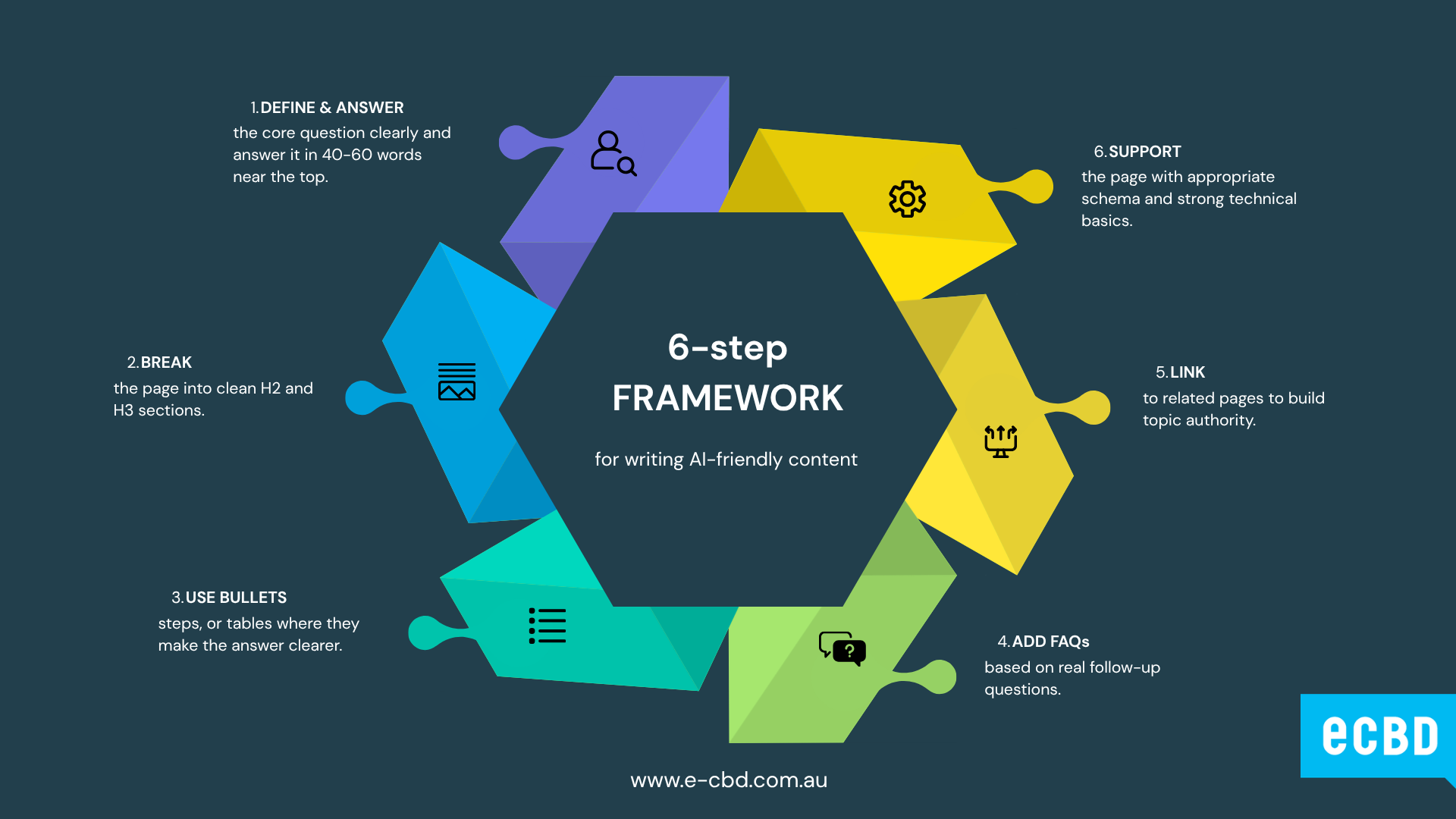
6-step framework for writing AI-friendly content
- Define the core question clearly and answer it in 40–60 words near the top.
- Break the page into clean H2 and H3 sections.
- Use bullets, steps or tables where they make the answer clearer.
- Add FAQs based on real follow-up questions.
- Link to related pages to build topic authority.
- Support the page with appropriate schema and strong technical basics.
Extra tip: Review for clarity, extractability and trust before publishing.
If a writer follows that process consistently, the content will usually become stronger for both AI-supported search and traditional search at the same time.
How to measure success in AI search
Success in AI search is not always measured the same way as traditional SEO. Rankings still matter, but they are no longer the only signal worth watching. A stronger approach is to look at a wider set of indicators that show whether your content is becoming more visible, more useful and more competitive in answer-led search environments.
Useful signals to watch include:
- improved visibility for question-led searches
- stronger performance on pages built around direct answers
- citation or mention presence in AI-led search experiences where you can observe it
- featured snippet visibility and overlap with answer-led results
- higher branded search lift after content improvements
- better engagement on pages built for extractability and clarity
- overall search traffic trends alongside AI visibility patterns
- more assisted discovery across informational and commercial content
This is one reason AI search strategy needs regular review. The goal is not just to publish once and hope for visibility. It is to keep refining the pages that already have the strongest chance of being surfaced, cited or used as trusted source material.
Continuous strategy auditing and refinement
Writing for AI search is not a one-time formatting exercise. It is an ongoing process of auditing what content already exists, identifying where pages are too vague or too dense, improving structure, strengthening proof, refreshing weak sections and tightening internal links across the topic cluster.
Over time, some pages will naturally emerge as stronger candidates for AI visibility than others. Those are the pages worth refining first. They may already rank well, already answer valuable questions or already sit close to the point where a clearer structure and better extractability could make a real difference.
The strongest approach is iterative. Review, improve, test, compare and keep refining. AI search is changing quickly, but pages built around clarity, usefulness and trust tend to remain more resilient than pages built around shortcuts.
Ready to write content that performs in AI search?
Writing for AI search is not about chasing a trick. It is about raising the quality of your content so it becomes easier to interpret, easier to trust and easier to surface when people are looking for answers. The businesses that do this well are not just writing more. They are writing more clearly, more strategically and with much stronger topical structure.
At eCBD, writing for AI search is not treated as a gimmick or a separate layer disconnected from SEO. The focus is on creating content that is clearer, more structured, more useful and more likely to support visibility across both traditional and answer-led search environments.
That means building answer-first pages, strengthening heading structure, adding summary blocks and FAQs, improving internal linking, clarifying entity relationships, supporting content with schema where it makes sense and building topic clusters that reinforce authority.
If you want to improve how your content performs in AI-supported search, eCBD can help. We build AI SEO strategies that combine answer-first writing, structured content, topical authority, internal linking, E-E-A-T and technical clarity so your pages are easier to rank, easier to cite and more useful across modern search environments. If this sounds like the kind of AI SEO partner you are looking for, get in touch with us, for more details.
Frequently Asked Questions
How do you write for AI search?
You write for AI search by creating clear, structured, trustworthy content that answers questions directly and is easy to extract. Strong headings, short paragraphs, lists, FAQs, examples and visible expertise all help.
How to prepare for AI search?
Start by improving your most important existing pages. Add direct answers, cleaner headings, more useful internal links, stronger examples, better sources and clearer trust signals before creating new content.
How to get listed in AI search?
There is no simple sign-up process. The practical way to improve your chances is to publish high-quality, well-structured content that search systems can confidently understand and surface.
How to stand out in AI search?
Stand out by being clearer, more specific and more useful than competing pages. Strong structure, better examples, stronger proof, stronger sources and deeper topic coverage usually matter more than writing more words.
What is the 30% rule for AI?
There is no single universal “30% rule” that content needs to follow to perform in AI search. What matters far more is clarity, structure, specificity, usefulness and trustworthiness.
Do you need special schema for AI search?
You do not need a special AI-only schema type, but structured data can still help search systems understand your content more clearly when used properly. Think of it as support, not a shortcut.
What content structure works best for AI search?
Answer-first content usually works best. A clear H1, direct intro answer, logical H2 and H3 headings, short paragraphs, bullets, tables and FAQs make pages easier to skim and easier to extract.
Can AI-friendly content still rank in traditional search?
Yes. In many cases, the same qualities that help content perform in AI search, such as clarity, structure, trust and relevance, also help it perform in traditional search.
Does writing for AI search mean writing differently for humans?
No. The goal is not to write for machines instead of people. The goal is to write clearly enough that both humans and AI-supported search systems can understand the page easily.
What is the difference between AI SEO and traditional SEO?
Traditional SEO is more focused on ranking pages in search results, while AI SEO is more focused on making content easy to interpret, extract and cite in answer-led environments. In practice, the strongest strategy usually uses both.
Do FAQs help with AI search visibility?
They often do, because they reflect real user questions and support concise, extractable answers. When they are relevant and well-written, FAQ sections can make a page more useful for both users and AI-supported search systems.
Can AI tools help you write for AI search?
Yes, AI tools can help with outlining, identifying gaps, refining structure and tightening explanations. They work best when they support a human-led strategy rather than replacing judgment, expertise and editorial quality.
Do you need backlinks and authority signals for AI search?
Authority still matters because AI-supported search systems are more likely to trust content that appears credible, well-supported and connected to a strong brand or website. Strong content structure helps, but trust signals still play an important role.
Does every article need a 40–60 word answer block?
Not every article needs that exact format, but concise direct-answer blocks near the top of important sections are often very useful. They make the main point easier to understand quickly and easier to extract.
