EEAT SEO Guide 2026: What E-E-A-T Means and How to Improve It
E-E-A-T is one of the clearest frameworks for understanding what high-quality content looks like in modern search. It is also one of the most misunderstood. Many businesses hear the term and assume it is a ranking factor, a page score or a technical setting they need to switch on. In reality, E-E-A-T is much more useful than that.
It helps explain why some websites feel credible, useful and worth trusting, while others feel generic, unreliable or thin. It helps explain why certain pages hold their search engine rankings over time, while others fade after broad quality-focused updates. And it helps explain why content quality now depends on much more than keyword placement alone.
That matters even more in 2026. Search engines are sorting through a huge volume of content, including AI-generated content, repetitive web content and weak reviews. At the same time, Google Search, AI Overview experiences and other AI platforms are putting more pressure on websites to prove that they are trustworthy sources, not just relevant pages.
This guide explains what EEAT means, why E-E-A-T still matters, how Google quality raters and search ranking systems use it conceptually, how to apply it to a real content strategy, and how to build better signals of trust, expertise, experience and authority across your website.
What Is E-E-A-T?
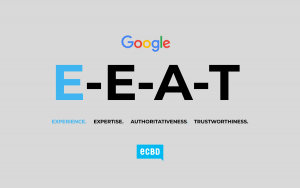
EEAT, or E-E-A-T, stands for Experience, Expertise, Authoritativeness and Trustworthiness. It comes from Google’s Search Quality Rater Guidelines and is used to evaluate content quality and credibility. In SEO, strong E-E-A-T means your content, author and website demonstrate real experience, credible expertise, strong reputation and visible trust signals that make them more useful to users and more reliable in search engine results.
Key Takeaways
- E-E-A-T means Experience, Expertise, Authoritativeness and Trustworthiness.
- It comes from Google’s Search Quality Rater Guidelines, which human quality raters use to assess search results.
- Trustworthiness is the most important pillar because even expert content can underperform if the page or website does not feel reliable.
- E-E-A-T is not a public score, but it still helps explain what strong content quality and credibility look like.
- Strong E-E-A-T supports better SEO, stronger user trust and better visibility in AI-driven environments.
- E-E-A-T matters especially for YMYL topics, but it also matters for commercial, informational and brand-led content more broadly.
What does E-E-A-T mean?
E-E-A-T stands for Experience, Expertise, Authoritativeness and Trustworthiness.
Google uses the concept in its Search Quality Rater Guidelines, which are used by human quality raters to assess whether search results appear helpful, accurate and trustworthy. These quality raters do not directly decide rankings, but the framework helps Google evaluate whether its search systems are surfacing the right kinds of pages.
That is why E-E-A-T matters in SEO. It gives website owners, marketers, writers and businesses a more useful framework for content quality than simply asking whether a page targets the right keyword.
Is it E-E-A-T or eat?
The current form is E-E-A-T. It used to be referred to as E-A-T, but Google later added an extra “E” for Experience.
The difference matters. Expertise, authority and trust are still central, but Google now also places more emphasis on whether the content creator has real first-hand or practical knowledge of the topic. In many search results, that practical experience is what makes the content feel useful rather than generic.
Definition and Components
The easiest way to understand EEAT is to break down each component clearly.
| Component | Definition | Common examples |
|---|---|---|
| Experience | First-hand, real-world knowledge of the topic | Case studies, reviews, screenshots, project examples, tutorials, practical insight |
| Expertise | Knowledge, skill or specialist understanding | Qualified authors, expert review, accurate explanations, strong depth |
| Authoritativeness | Reputation and recognition in a niche | Backlinks, brand mentions, industry publications, positive website reputation |
| Trustworthiness | Reliability, transparency, legitimacy and safety | HTTPS, contact information, cited sources, updated content, secure site experience |
E-E-A-T is not about one signal in isolation. It is the combined quality picture created by your content, your content creator, your website, your business and your broader online reputation.
Why E-E-A-T Matters for SEO
Importance of E-E-A-T in modern SEO
E-E-A-T matters because search engines want to surface results that are useful and trustworthy, not just relevant in the narrowest sense. A page may target the correct keyword and still perform poorly if it looks vague, unsupported or low quality compared with stronger competitors.
Impact on content quality
High E-E-A-T usually overlaps with high content quality. Strong content tends to be accurate, well-supported, clearly written, useful to the user and obviously created by someone who understands the topic.
Role in search rankings
E-E-A-T is not a simple ranking factor with a visible score. But it strongly influences how well a page aligns with the types of quality signals search engines are trying to identify and prioritise.
Role in search engine results pages
As search engine results pages become more competitive and more answer-led, websites need more than keyword relevance. They need stronger trust signals, stronger reputation signals and stronger content quality. E-E-A-T helps explain how that quality shows up.
Connection to user experience
User experience also matters here. A website that feels cluttered, unclear, anonymous or hard to trust weakens its own E-E-A-T signals. Strong content and strong usability tend to reinforce one another.
Is E-E-A-T Still Relevant?
Yes, E-E-A-T is still highly relevant, and arguably more relevant than ever.
Search is not dying — it is evolving. Search engines still need to decide what deserves visibility. In 2026, that means they need stronger ways to identify content quality, website credibility and trustworthy sources, especially in a web environment crowded with AI-generated material and low-value summaries.
E-E-A-T is also highly relevant because it connects directly to long-term visibility. Websites that build stronger signals of experience, trust and authority are more likely to perform well over time, especially when Google algorithms shift toward more helpful, people-first content.
How Google Uses E-E-A-T
Search Quality Rater Guidelines
Google’s Search Quality Rater Guidelines are the formal source of E-E-A-T. Human quality raters use them to evaluate whether search results appear useful, reliable and aligned with Google’s quality standards.
Search quality raters and search ranking systems
Search quality raters do not manually rank your website. Their role is to provide feedback that helps Google assess whether its search ranking systems are surfacing strong results.
Helpful content and people-first content
E-E-A-T aligns closely with Google’s helpful content direction. Pages created mainly for people are more likely to demonstrate strong experience, expertise, authority and trust than pages created mainly to chase rankings.
Google algorithms and core updates
While Google does not describe every update as an “E-E-A-T update”, the framework helps explain why low-trust or low-quality pages often struggle when Google algorithms become better at surfacing credible content.
How Google Evaluates E-E-A-T Signals
Google does not use one simple E-E-A-T score. Instead, it evaluates many patterns and signals that together suggest whether a page, website and content creator are credible.
Page-level signals
- clarity of the content
- depth of the page
- accuracy of claims
- quality of reviews and examples
- use of reputable sources
- content architecture and readability
Author-level signals
- author credentials
- author bios
- author pages
- subject matter relevance
- evidence of first-hand experience
Website-level signals
- website reputation
- business transparency
- contact details
- privacy and trust pages
- secure site experience
- consistency of web content
Off-page and reputation signals
- online citations
- reviews and ratings
- brand sentiment
- brand perception
- mentions in industry publications
- backlinks from reputable websites
Breaking Down Each Component of E-E-A-T
Experience: Demonstrating First-Hand Knowledge
Experience is about whether the content creator has actually done the thing they are writing about. This is why first-hand examples, case studies, screenshots, reviews and project outcomes can make content stronger.
Experience is especially valuable for:
- product reviews
- service pages
- tutorials
- comparison content
- problem-solving guides
For example, a service page backed by real campaign insights, screenshots and outcomes is more compelling than a page that simply describes the service in abstract terms.
Expertise: Showcasing Deep Knowledge
Expertise is about demonstrating knowledge, skill and understanding. For some topics, that means formal credentials. For others, it means deep practical understanding that is visible in the quality of the explanation.
Expertise often shows up through:
- accurate explanations
- technical depth
- specialist terminology used correctly
- expert review
- clear answers to nuanced questions
Authoritativeness: Becoming a Recognised Industry Leader
Authoritativeness is about recognition and reputation. A page or website becomes more authoritative when it is treated as a source worth referencing by others in the field.
This can be reinforced through:
- backlinks
- mentions from reputable sites
- strong branded search presence
- positive reviews
- industry citations
- consistent topic coverage
Trustworthiness: Ensuring Accuracy and Reliability
Trustworthiness is the most important pillar because it underpins everything else. A site can appear experienced and knowledgeable, but if users do not trust it, the overall quality picture weakens.
Trust can be improved through:
- secure browsing
- clear contact details
- transparent ownership
- strong sourcing
- updated information
- honest claims
- clear editorial standards
How to Improve Your E-E-A-T
Create helpful content
Start with genuinely useful content. Helpful content is usually clearer, more specific, more structured and more trustworthy than content designed mainly to manipulate search engines.
Follow strict editorial standards
Fact-check claims, review sensitive content, keep important pages current and make sure content is consistent in quality across the whole website.
Build your brand reputation
Authority is not only about individual pages. It is also about whether your business is recognised as a reputable brand. Reviews, online citations, mentions and overall reputation signals all matter here.
Credit your content creators
Named authors, author bios, reviewer notes and subject matter experts all help strengthen both expertise and trust.
Use credible sources
Strong sourcing matters, especially for claims, facts, technical information and advice. Reputable sources and primary sources are especially valuable.
Leverage user-generated content
Reviews, testimonials and feedback can reinforce both trust and practical experience when they are genuine and relevant.
Regularly update content
Outdated pages weaken trust. Refresh content, review screenshots, update claims and revisit important pages regularly.
Practical Steps to Align Your Website with E-E-A-T
- Audit your most important pages for weak experience, expertise, authority and trust signals.
- Strengthen your author bios and author pages so users know who created the content.
- Add stronger evidence such as case studies, reviews, screenshots and examples.
- Improve your sourcing and replace weak references with more credible sources.
- Strengthen internal links between relevant pages to build content pillars and topic depth.
- Improve sitewide trust pages like About, Contact, Policies and service transparency pages.
- Review your website reputation by checking reviews, mentions and how your brand appears in search results.
- Refresh important pages regularly to keep them reliable and current.
This is also where broader search engine optimisation still matters. E-E-A-T does not replace strong SEO fundamentals. It strengthens how your content performs when relevance, intent and content strategy are already being handled properly.
How E-E-A-T Impacts Google Algorithm Updates
Google’s core updates often reinforce the value of strong content quality, trust and usefulness. They do not always mention E-E-A-T directly, but the framework helps explain why some websites lose visibility while others remain stable or improve.
Low-trust content, weak reviews, vague expertise and poor website reputation can all become more problematic when Google gets better at evaluating quality. On the other hand, websites that invest in stronger trust signals, stronger sourcing and better content strategy are often more resilient.
E-E-A-T and AI-Generated Content
Over-reliance on AI-generated content is one of the clearest modern risks to E-E-A-T. AI tools can help with ideation, page templates and drafts, but generic AI-generated material often lacks first-hand experience, original evidence and genuine expertise.
This is especially important in AI-driven environments such as AI Overview experiences and other AI platforms where trust and extractability matter. If content looks generic or unsupported, it becomes much harder to trust and much easier to replace.
That is why E-E-A-T now overlaps strongly with writing for AI search and AI SEO. Search is becoming more answer-led, which means credibility and trust matter even more.
Some teams now use tools such as an AI Search Grader, share-of-voice tracking or Enterprise AIO-style reporting to assess how brands appear across AI platforms. Those tools can be useful, but the underlying principle stays the same: if the content is not trustworthy, the technology layer will not save it.
E-E-A-T, Website Reputation and Brand Signals
One of the biggest mistakes people make is treating E-E-A-T like an article-only issue. In reality, E-E-A-T is also shaped by website reputation, brand authority, reviews and how the broader web talks about your business.
That is why signals such as:
- online citations
- brand mentions
- industry publications
- reviews and ratings
- brand sentiment
- share of voice
can all reinforce authoritativeness and trustworthiness over time.
This is also one reason local businesses should not ignore off-page trust signals such as a well-maintained Google Business Profile, customer reviews and consistent business information. For some businesses, these signals support brand authority as much as the website content itself.
Examples of E-E-A-T in Action
Expert and content brands
Publishers such as Search Engine Journal are often referenced in E-E-A-T discussions because their content is clearly expert-led, tied to named contributors, and built around practical search knowledge. Strong topic coverage, recognised industry reputation, and useful, experience-backed explanations make these pages more valuable than generic summaries.
Business websites
Brands such as Semrush are often used as stronger examples of E-E-A-T because they combine product expertise, educational content, visible author and reviewer signals, original data, and broad brand authority in the SEO space. That mix of expertise, transparency, reputation, and content depth helps reinforce quality across the whole site.
Service and repair brands
Whether the example is a service brand, a retailer or a specialist publisher, the pattern is usually the same: stronger websites combine useful content, clear authorship, visible trust signals, strong reviews, better sourcing and a more credible overall brand presence.
Common Pitfalls to Avoid
- treating E-E-A-T like a public score
- adding author bios but leaving the content weak
- publishing AI-generated content without meaningful review
- using weak or no sources for important claims
- ignoring website reputation and brand perception
- failing to update important content regularly
- assuming only huge brands can build authority
- ignoring user engagement and click-through rate signals when assessing whether content actually satisfies users
Future-Proofing Your SEO Strategy
If SEO is evolving rather than dying, then E-E-A-T is part of that evolution. It helps future-proof content by focusing on the qualities that still matter no matter how search engines change: trust, usefulness, expertise, reputation and credibility.
Whether users discover your website through Google SERPs, AI Overview features, or newer answer-led systems, the core question remains similar: does this content deserve trust?
That is why E-E-A-T should be built into your content marketing strategy, your page template decisions, your content architecture, your internal links, your author setup and your sitewide trust pages — not simply added at the end as an SEO afterthought.
E-E-A-T Checklist
- Author is named
- Author credentials or relevant experience are visible
- Author bios and author pages support credibility
- Content includes first-hand examples, screenshots, reviews or case studies where relevant
- Claims are backed by reputable and ideally primary sources
- Website uses HTTPS and feels secure
- Contact details, About page and trust pages are easy to find
- Internal links support content pillars and topical authority
- Backlinks, online citations and reviews support reputation
- The page feels useful, transparent and trustworthy to a first-time visitor
Closing Thoughts
E-E-A-T is not just another SEO buzzword. It is one of the clearest frameworks available for understanding what trustworthy, helpful and credible content looks like in modern search.
That is why it still matters. Search engines want to surface reliable information. Users want to rely on trustworthy sources. Businesses that build stronger experience, expertise, authority and trust are in a much better position to satisfy both.
Need help building stronger SEO content?
If you want content that is clearer, more trustworthy and better positioned for both traditional SEO and modern AI-supported search, eCBD can help. We build SEO strategies around stronger content quality, better trust signals, better content architecture and long-term visibility. Contact us so we can turn our expertise and experience into your online reality.
Frequently Asked Questions
What does E-E-A-T mean?
E-E-A-T stands for Experience, Expertise, Authoritativeness and Trustworthiness. It is Google’s framework for evaluating content quality and credibility.
Is it E-E-A-T or eat?
The current version is E-E-A-T. It used to be E-A-T, but Google later added the extra “E” for Experience.
Is E-E-A-T still relevant?
Yes, E-E-A-T is still highly relevant. It remains one of the clearest frameworks for understanding trustworthy, people-first content in SEO.
How to use E-E-A-T in SEO?
You use E-E-A-T by strengthening visible credibility signals such as author information, first-hand examples, reputable sources, content quality, internal links and site trust signals.
Is E-E-A-T a ranking factor?
Not as a simple public score or switch. It is better understood as a framework that helps explain the quality signals strong content tends to demonstrate.
What is the meaning of YMYL? Why is E-E-A-T important for it?
YMYL means “Your Money or Your Life” and refers to topics where poor information can affect health, safety, finances or major life decisions. E-E-A-T matters more strongly there because trust and expertise are much more important.
Is SEO dead or evolving in 2026?
SEO is evolving, not dead. What is changing is the standard for content quality, trust, usefulness and credibility, which is exactly why E-E-A-T remains so important.
