Technical SEO: What It Is and Why It Matters for AI Search
Technical SEO is often treated like background maintenance, but it is really the infrastructure that makes the rest of search engine optimisation possible. You can publish excellent content, improve your backlink profile, refine your On-page SEO and target the right search intent, but if search engines cannot crawl, render, understand and index your website properly, that work will underperform.
That point matters even more now. Technical SEO is no longer just about helping Googlebot access pages for Google Search. It also influences whether your content can be discovered and interpreted by AI systems, including AI crawlers and platforms that generate summaries or AI-generated answers. If your technical foundation is weak, your pages may struggle to appear in traditional search engine results and in newer AI-led environments.
This guide explains what Technical SEO is, why it matters, what it includes, what a proper technical SEO audit should cover, and how it supports both classic search visibility and modern AI visibility.
Key Takeaways
- Technical SEO makes it easier for search engines and AI systems to access, understand and index your content.
- It includes crawlability, indexability, rendering, site architecture, page experience and structured data.
- Strong content can still underperform if the technical foundation is weak.
- Technical SEO still matters in 2026 because SEO is evolving, not dying.
- Technical SEO supports both traditional rankings and AI visibility.
What Is Technical SEO?
Technical SEO is the part of SEO focused on helping search engines crawl, render, understand and index your website efficiently. It covers things like crawlability, indexability, site architecture, URL structure, robots.txt, XML sitemap, Schema Markup, Page speed, Core Web Vitals, Canonical tags, 301 redirects and other technical signals that affect search engine rankings, search traffic and AI visibility.
Where content SEO focuses on the words, messaging and relevance of a page, Technical SEO focuses more on the technical foundation underneath it. That includes whether the site can be crawled, whether pages are indexable, whether scripts render correctly, whether internal links help discovery, whether duplicate content is controlled, and whether the website delivers a strong Page Experience.
Technical SEO is not separate from content. It supports it. Great web content still needs the right technical setup in order to earn visibility in Google Search and other search engine results.
Why Is Technical SEO Important?
Technical SEO is important because a website can be relevant and still be difficult for search engines to process. If crawling, indexing or rendering fail, your pages may never get the visibility they deserve.
It supports crawlability and indexability
A page first needs to be crawled before it can be evaluated, and it needs to be indexable before it can rank. Technical SEO helps make sure important URLs can be discovered, crawled and stored correctly in search engine indexes.
It protects search engine rankings
Technical issues can quietly damage search engine rankings. Broken canonical logic, blocked pages, rendering problems, slow website speed, messy site structure or poor redirect handling can all hold a site back even when the content itself is solid.
It improves user experience
User experience matters because slow, unstable or confusing pages are harder to use. Technical SEO overlaps strongly with usability through cleaner architecture, faster loading, better mobile behaviour and easier navigation.
It supports AI visibility
If a page cannot be crawled, rendered or understood cleanly, it is less likely to be surfaced in AI-led search. Strong Technical SEO helps content remain accessible not just for classic search engines, but also for systems that generate summaries, answers and citations.
What Are the 4 Types of SEO?
The four most common SEO categories are:
- Technical SEO – crawlability, indexability, rendering, site architecture, structured data and technical foundations
- On-page SEO – content, headings, Meta tags, internal optimisation, keyword targeting and page-level improvements
- Off-page SEO – backlinks, mentions, citations, digital PR and wider authority signals
- Local SEO – location-based visibility, local intent, map presence and local business optimisation
All four matter, but Technical SEO is what allows the rest to work more effectively.
What Are Some Examples of Technical SEO?
Technical SEO covers a wide range of activities. Common technical SEO examples include:
- improving crawlability
- fixing crawl errors
- reviewing and optimising robots.txt
- maintaining a clean XML sitemap
- improving Page speed and overall website speed
- improving Core Web Vitals
- resolving Duplicate content
- using Canonical tags correctly
- implementing Schema Markup and structured data markup
- cleaning up URL structure
- strengthening internal linking
- fixing a Broken link issue
- managing 301 redirects and avoiding redirect chains
- supporting Mobile-first indexing with strong mobile usability
- using HTTPS backed by a valid SSL certificate
Core Areas of Technical SEO
Crawlability
Crawlability is about whether search engines can access and move through your website efficiently. A technically healthy site makes it easy for crawlers to discover important pages through good structure and strong internal linking.
Indexability
Indexability is about whether a page can be included in search engine results. A page can exist and even be crawlable but still not rank if it is not indexable for technical reasons.
Rendering
Rendering is how search engines process the page and interpret what is actually on it. Heavy JavaScript, missing assets or rendering problems can make content harder for a search engine to understand.
Site architecture and site structure
Site architecture and site structure shape how pages relate to one another. Clear hierarchy improves discovery, helps distribute importance and makes it easier for users and search engines to navigate your content.
Robots.txt
The robots.txt file helps control crawler access. Used correctly, it supports efficient crawling. Used badly, it can block valuable pages from Google Search and other search engines.
XML sitemap
An XML sitemap helps highlight important URLs for search engines. It should be kept current and should point to live, useful, indexable pages.
Schema Markup and structured data
Schema Markup and structured data help search engines interpret what your page is about. They support machine readability and can help pages become eligible for Rich Results and, in some cases, more visually enhanced Rich snippets.
Page speed and site speed
Page speed and site speed matter because slow-loading pages frustrate users and can weaken crawl efficiency. Faster websites are generally easier to use and easier to crawl.
Core Web Vitals
Core Web Vitals measure loading performance, interactivity and visual stability. The most commonly discussed metrics include Largest Contentful Paint and Cumulative Layout Shift. Historically, First Input Delay was also used as a Core Web Vitals metric, and many SEO tools and articles still reference it.
Duplicate content and canonicals
Duplicate content can create confusion when multiple pages compete to represent the same content. Canonical tags help clarify which version should be treated as the preferred URL.
URL structure
A clean URL structure makes pages easier to understand and manage. Logical URLs help both users and search engines interpret where a page sits within the site.
HTTPS and site security
A technically sound site should use HTTPS supported by a valid SSL certificate. This is now a basic trust and performance expectation, not an optional extra.
Technical SEO and AI Search Visibility
Technical SEO now plays a more obvious role in AI SEO and AI visibility. AI systems still rely on pages being accessible, structured and understandable.
If a page cannot be crawled properly, is badly rendered, or has weak structure, it is less likely to be discovered and used in AI-generated answers. This is why technical SEO is no longer just about rankings. It is also about machine accessibility and machine readability.
Structured data supports AI interpretation
Structured data and Schema Markup make it easier for machines to interpret page types, entities and relationships. This supports clearer understanding across both search engines and AI systems.
Good architecture supports discoverability
Strong site architecture, clean internal links and sensible URL hierarchies help AI systems and search engines discover important content more reliably.
Technical SEO supports trustworthy content delivery
Even strong content can be overlooked if the technical foundation makes it hard to access, understand or trust. Technical SEO supports the delivery side of content visibility.
Technical SEO Tools and Reports Worth Using
A good technical SEO audit usually relies on a mix of tools rather than one platform alone.
Google Search Console and Search Console reports
Google Search Console is one of the most useful free tools for technical SEO. Search Console helps identify indexing issues, coverage problems, sitemap errors, performance changes and signals that can affect visibility in Google Search.
Useful Google Search Console areas to check include:
- indexing reports
- sitemap submissions
- page experience signals
- Core Web Vitals reporting
- manual coverage or crawl issues
Screaming Frog
Screaming Frog is one of the most widely used tools for technical crawling. It is useful for finding crawl errors, blocked pages, redirect issues, broken links, missing metadata, canonical problems and internal linking issues.
PageSpeed Insights
PageSpeed Insights is useful for reviewing Page speed, Largest Contentful Paint, Cumulative Layout Shift and other performance indicators tied to page experience.
Rich Results Test
The Rich Results Test helps validate whether your structured data markup is eligible for supported enhanced search appearances such as Rich Results.
Log file analysis
Log file analysis can help advanced SEO teams understand how search engine crawlers and AI crawlers are actually interacting with the site. It is especially useful on larger websites.
What a Technical SEO Audit Should Cover
A strong technical SEO audit should review the full technical foundation of the site, not just one or two metrics.
Audit areas should include:
- crawlability and indexability
- robots.txt rules
- XML sitemap health
- Google Search Console coverage issues
- Google Search visibility issues
- Page speed and website speed
- Core Web Vitals
- duplicate content and Canonical tags
- internal linking and site architecture
- structured data and Schema Markup
- redirect issues including 301 redirects and redirect chains
- HTTPS, SSL certificate and security basics
Page Experience and Performance Signals
Page Experience is not the whole of Technical SEO, but it is a meaningful part of it. A technically healthy site should load well, behave predictably and work properly across devices.
Page speed and website speed
Page speed and overall website speed affect user satisfaction and crawl efficiency. Slow websites can also create frustration that hurts engagement and conversion potential.
Largest Contentful Paint
Largest Contentful Paint measures how quickly the main content area becomes visible. A slow LCP usually means the page feels slow to users.
Cumulative Layout Shift
Cumulative Layout Shift measures visual stability. If content jumps while loading, the page feels unreliable and frustrating.
Responsive web design and mobile-first indexing
Responsive web design supports a stronger mobile experience, and that matters because Mobile-first indexing means Google primarily looks at the mobile version of a site when assessing content and structure.
Other Technical SEO Issues That Commonly Hold Sites Back
- important pages blocked in robots.txt
- pages that are crawlable but not indexable
- weak site structure
- poor internal links and internal linking paths
- duplicate content without proper canonicals
- slow page speed
- rendering issues
- missing schema or weak structured data
- broken links and a lingering Broken link problem
- messy redirects and redirect chains
- Meta tags that conflict with the intended indexing setup
Does Technical SEO Still Matter in 2026?
Yes. Technical SEO still matters in 2026 because SEO is evolving, not disappearing.
What has changed is that technical SEO is now clearly tied to both classic search and AI search. Search engines and AI systems still need accessible, structured and trustworthy websites. If they cannot discover and interpret the content, your visibility will suffer.
Technical SEO in 2026 is about more than maintenance. It is about discoverability, clarity, performance, machine readability and protecting long-term visibility in search.
A Practical Technical SEO Checklist
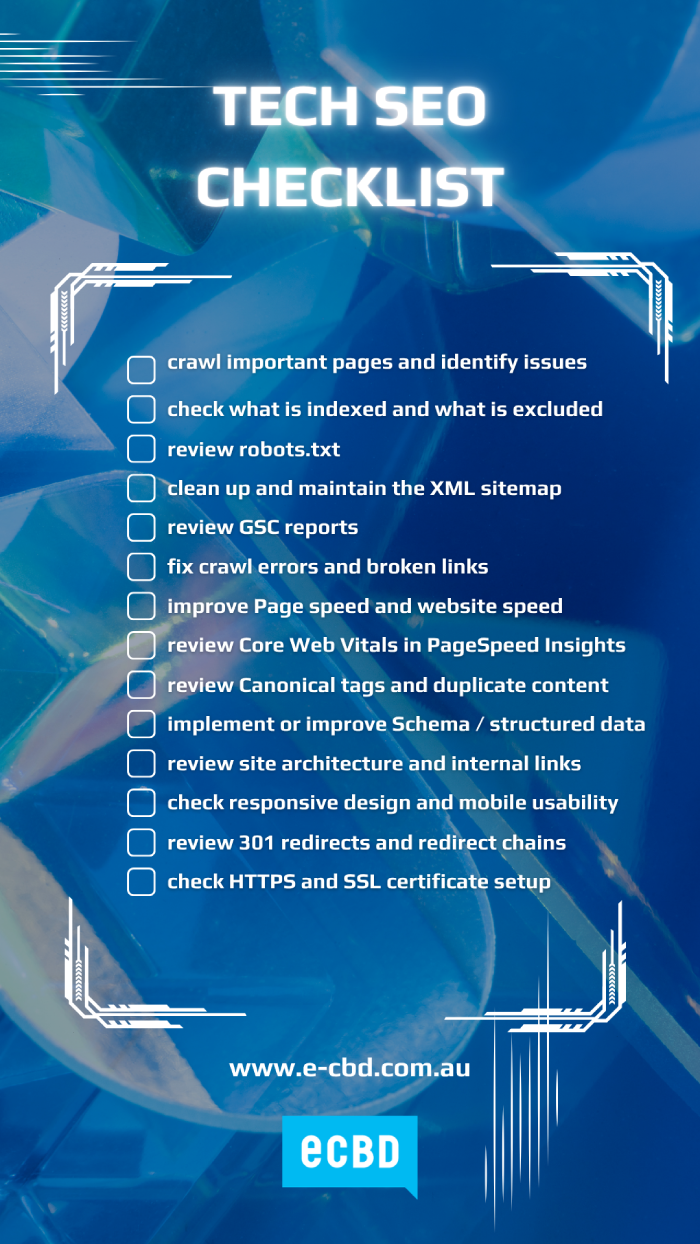
- crawl important pages and identify crawl issues
- check what is indexed and what is excluded
- review robots.txt
- clean up and maintain the XML sitemap
- review Google Search Console and Search Console reports
- fix crawl errors and broken links
- improve Page speed and website speed
- review Core Web Vitals in PageSpeed Insights
- review Canonical tags and duplicate content
- implement or improve Schema Markup and structured data markup
- review site architecture and internal linking
- check responsive web design and mobile usability
- review 301 redirects and remove redirect chains
- check HTTPS and SSL certificate setup
Summing up what we’ve learnt about Technical SEO
Technical SEO is the foundation that allows content, links and strategy to work properly. It still matters in 2026 because both traditional search engines and AI systems need websites to be accessible, structured and understandable.
If your technical foundation is weak, even excellent content can struggle to earn search engine rankings and search visibility. If your technical foundation is strong, it becomes much easier for Google Search and AI systems to discover, understand and surface your content.
Need help with technical SEO or AI visibility?
If you want help with a technical SEO audit, improving crawlability and indexability, or preparing your website for stronger AI visibility, eCBD can help. Get in touch with us, today.
Frequently Asked Questions
What is technical SEO?
Technical SEO is the part of search engine optimisation focused on helping search engines crawl, render, understand and index your website properly. It includes areas such as crawlability, indexability, site speed, structured data and site architecture.
Why is technical SEO important?
Technical SEO is important because strong content can still underperform if search engines cannot access or interpret it properly. It also supports user experience, site health and AI visibility.
What are the 4 types of SEO?
The four common types are Technical SEO, On-page SEO, Off-page SEO and Local SEO. Technical SEO provides the foundation for the others to work effectively.
What are some examples of technical SEO?
Examples include improving crawlability, fixing crawl errors, maintaining robots.txt and XML sitemap files, improving Page speed, using Canonical tags, implementing Schema Markup and strengthening site structure.
Does technical SEO still matter in 2026?
Yes, technical SEO still matters in 2026. SEO is evolving, and clear technical foundations are increasingly important for both traditional search visibility and AI visibility.
How does technical SEO affect AI search?
Technical SEO affects AI search by helping content remain crawlable, indexable, structured and machine-readable. If content cannot be discovered or understood properly, it is less likely to support strong AI-generated answers.
What should be in a technical SEO checklist?
A technical SEO checklist should cover crawlability, indexability, robots.txt, XML sitemap health, Google Search Console, page speed, Core Web Vitals, canonicals, structured data, site architecture, internal linking and mobile usability.
